This article teaches about the biblical passages that Isaac Watts referred to when he wrote the poem that we now know as "Joy to the World."
Introduction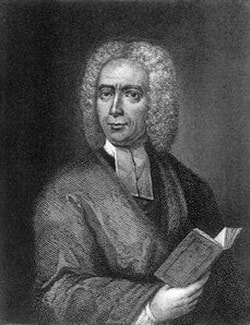 Isaac Watts (1674-1748) (Ref. 2) Isaac Watts (1674-1748) (Ref. 2)
In 1719, Isaac Watts published a poem about Psalm 98:4-9, Psalm 96:11-13, and Genesis 3:17-18. He titled the poem, The Messiah's Coming and Kingdom (Ref. 1, Ref. 2). Today we know that poem by the title, "Joy to the World," from the first line of the first verse:
"Joy to the World; the Lord is come! Let earth receive her King! Let ev'ry heart prepare Him room, And Heaven and nature sing." (Ref. 1) More than a century later, in 1836, Lowell Mason set the words of the poem, "Joy to the World," to music (Ref. 3). Musically, Mason borrowed the first four notes for his tune from the chorus, "Lift Up Your Heads," in Handel's Messiah (Ref. 1). As of the late 20th century, "Joy to the World" was the most-published Christmas hymn in North America" (Ref. 1). Scriptures for "Joy to the World"Psalm 98:4-9 KJV -- "Make a joyful noise unto the Lord, all the earth: make a loud noise, and rejoice, and sing praise. (5) Sing unto the Lord with the harp; with the harp, and the voice of a psalm. (6) With trumpets and sound of cornet make a joyful noise before the Lord, the King. (7) Let the sea roar, and the fulness thereof; the world, and they that dwell therein. (8) Let the floods clap their hands: let the hills be joyful together (9) Before the Lord; for he cometh to judge the earth: with righteousness shall he judge the world, and the people with equity."
Psalm 96:11-13 KJV -- "Let the heavens rejoice, and let the earth be glad; let the sea roar, and the fulness thereof. (12) Let the field be joyful, and all that is therein: then shall all the trees of the wood rejoice (13) Before the Lord: for he cometh, for he cometh to judge the earth: he shall judge the world with righteousness, and the people with his truth."
Genesis 3:17-19 KJV -- "And unto Adam he said, Because thou hast hearkened unto the voice of thy wife, and hast eaten of the tree, of which I commanded thee, saying, Thou shalt not eat of it: cursed is the ground for thy sake; in sorrow shalt thou eat of it all the days of thy life; (18) Thorns also and thistles shall it bring forth to thee; and thou shalt eat the herb of the field; (19) In the sweat of thy face shalt thou eat bread, till thou return unto the ground; for out of it wast thou taken: for dust thou art, and unto dust shalt thou return."
The beautiful carol, "Joy to the World," that we love to sing at Christmas actually is more about the second coming of Christ than the first (the incarnation - John 1:14). Psalm 98:4-9 and Psalm 96:11-13 glorify Christ's triumphant return at the end of the age. The Apostle Paul, writing after the first coming of Christ, tells us the whole creation still groans and is subject to corruption (including destruction and decay) (Romans 8:21-22, Ref. 4). The time still is in the future when the sea will roar in praise, the floods will clap their hands, and the "trees of the wood" will rejoice when Christ comes to judge the world (Psalm 98:7-9, Psalm 96:12-13). Verses 1 and 2 of "Joy to the World" look forward to this time of rejoicing.
When Christ comes again he will establish his reign upon the earth. He will judge (the Hebrew word means to act as law-giver, judge, governor) the world with righteousness, truth, and grace (Psalm 98:9, Psalm 96:13, John 1:14, Ref. 5). Verse 4 of "Joy to the World" expresses this truth.
Genesis 3:17-19 describes the curse that God announced to Adam after Adam had sinned by eating the fruit from the forbidden tree. This passage specifically mentions the curse on the ground, the sorrow that Adam (mankind) will have toiling the ground, and that the ground will grow thorns (Genesis 3:17-18). In Verse 3 of "Joy to the World," the hymn looks forward and says, "No more let sins and sorrows grow, nor thorns infest the ground." When Christ comes, he "will make his blessings flow ... far as the curse is found." We can receive Christ's blessings now and become free from the eternal curse of sin by putting our faith, confidence, and trust in him today (Ephesians 2:8-9, Romans 3:23-24, John 11:25-26).
Hymn Writer and Composers for "Joy to the World"Three different men from three different backgrounds have collaborated in mind and spirit to create the carol, "Joy to the World," that people have enjoyed for more than 180 Christmases. Isaac Watts (1674-1748) was an English Independent (Congregational) minister, theologian, and a prolific and popular hymn writer. Watts composed more than 700 hymns (Ref. 2). Many of his hymns remain in use today including "When I Survey the Wondrous Cross," "From All That Dwell Below the Skies," and "Marching to Zion" (Ref. 2). 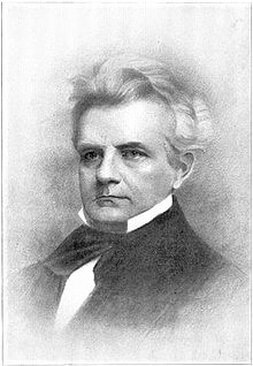 Lowell Mason (1792-1872) (Ref. 3) Lowell Mason (1792-1872) (Ref. 3)
Lowell Mason (1792-1872) was an American choir director, music educator, and composer in Boston and New York City (Ref.3). In 1836 he rearranged a section of Handel’s "Messiah" to fit the words of "Joy to the World." That familiar hymn tune we sing today for "Joy to the World" is named Antioch (Ref. 1). Lowell Mason also is known for his hymn tune, "Nearer, My God, to Thee," and for the melody he created for the nursery rhyme, "Mary Had a Little Lamb" (Ref.3).
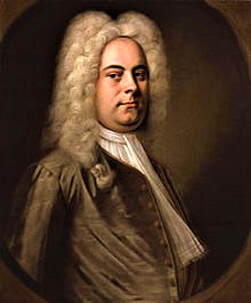 George Frideric Handel (1685-1759) (Ref. 6) George Frideric Handel (1685-1759) (Ref. 6)
George Frideric Handel (1685-1759) was a German, later British, Baroque composer who spent the bulk of his career in London (Ref. 6). Handel composed his masterpiece oratorio, Messiah, in 1741 (Ref. 7). Lowell Mason's Antioch tune for "Joy to the World" borrows the first four notes from the chorus, "Lift Up Your Heads," in Handel's Messiah (Ref. 1).
Even though Isaac Watts wrote "Joy to the World" about the second coming of Christ, "Joy to the world" applies to us today when we celebrate the first coming of Christ. First, our hearts are to "prepare him room" (Luke 2:7, Verse 1). Second, we are to celebrate the "wonders of his love" (Verse 4). The Bible tells us about God's wonderful love -- "God so loved the world that He gave His only begotten Son, that whoever believes in Him should not perish but have everlasting life" (John 3:16).
Consider
Have you prepared room in your heart for Jesus? (Luke 2:7) Have you received Jesus who came to save you and me from our sins? (Matthew 1:20-21) Are you prepared to meet Jesus Christ joyfully when he comes to judge the world? (Psalm 98:4, 9; Psalm 96:11, 13)
References
1. https://en.wikipedia.org/wiki/Joy_to_the_World 2. https://en.wikipedia.org/wiki/Isaac_Watts 3. https://en.wikipedia.org/wiki/Lowell_Mason 4. https://biblehub.com/greek/5356.htm 5. https://biblehub.com/hebrew/8199.htm 6. https://en.wikipedia.org/wiki/George_Frideric_Handel 7. https://en.wikipedia.org/wiki/Messiah_(Handel)
0 Comments
Updated - 13 June 2024
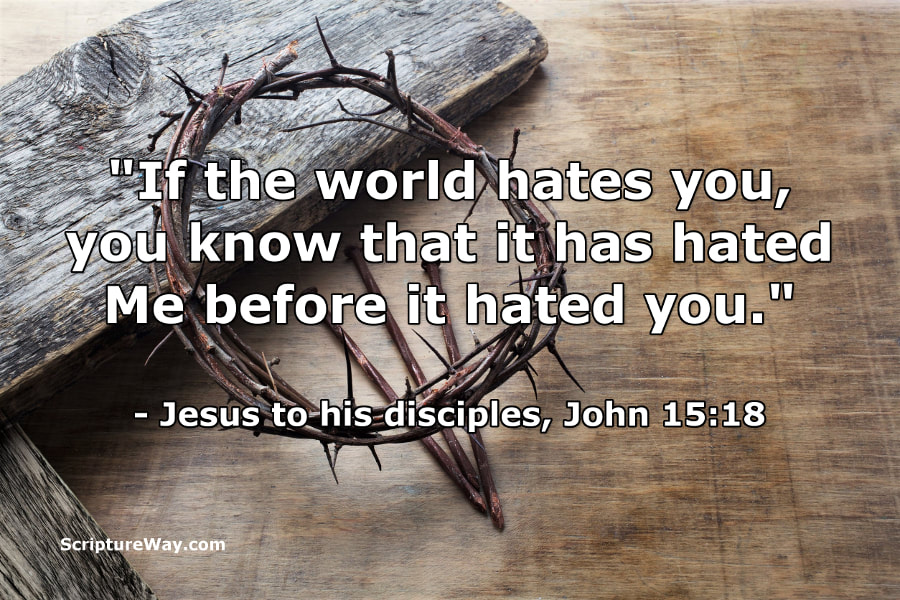
Jesus-Crown-Thorns_John 15:18_123RF Photo - Used Under License
"If the world hates you, you know that it has hated Me before it hated you. If you were of the world, the world would love its own; but because you are not of the world, but I chose you out of the world, because of this the world hates you." (John 15:18-19)
This lesson is the third in the series on "Christians and the World" (Ref. 1, Ref. 2). This lesson explains why "the world" hates Jesus and his disciples. This lesson also explains the scriptural basis for joy when Jesus' disciples (that is, we who believe in him) encounter the world's hatred.
The scriptures in this lesson are quoted from the New American Standard Bible (NASB) unless noted otherwise (Ref. 3).
Consider. Have you experienced the world's hatred because you are Christ's disciple? Do you see the world's opposition to yourself or to Christians in general as a cause for joy?
Biblical definition of "the world"
"For God so loved the world, that He gave His only Son, so that everyone who believes in Him will not perish, but have eternal life." (John 3:16)
Let's revisit the definition of "the world" from the first lesson in this series, "Biblical Definition of the World" (Ref. 1). The Greek word for "the world" in the New Testament is kosmos. In the New Testament, and particularly in the Gospel of John, kosmos is used in five ways:
The main scriptures for this lesson, John 7:7 and John 15:18-19, refer to the fourth definition above for "the world" -- "people who are hostile to Christ and to Christ's followers."
Biblical definition of "hate"
"For not even His brothers believed in Him. So Jesus said to them, 'My time is not yet here, but your time is always ready. The world cannot hate you, but it hates Me because I testify about it, that its deeds are evil.'" (John 7:5-7)
Let's look at the definition of the Greek word for hate. The Greek word for hate used in John 7:7 and John 15:18-19 is miseó (pronounced mis-eh'-o) (Ref. 4). Miseó means "to detest (on a comparative basis); to love someone or something less than someone (something) else; to renounce one choice in favor of another" (HELPS Word-studies - Ref. 4). Note that according to this definition, hate involves making a choice - for example, whether to love Jesus or not to love Jesus. We see the same Greek word used for hate throughout the New Testament, for example, in Matthew 5:43-44, Mark 13:13, Luke 16:13, John 3:19-20, Romans 7:15, 1 John 2:11, and Revelation 2:6.
Yes, the world hates Jesus
When Jesus spoke to his half-brothers who did not believe in him, Jesus said, "The world cannot hate you, but it hates Me because I testify about it, that its deeds are evil" (John 7:7, Matthew 13:55). Examples of evil deeds that Jesus pointed out to his adversaries include unbelief (John 8:21-24) and hypocrisy (Matthew 23:13-15, 23). Jesus also told his adversaries that their father was the devil (John 8:44). That is why his "opposers" hated Jesus. American theologian Albert Barnes wrote, "This was the main cause of the opposition which was made to him. He proclaimed that men were depraved, and the result was that they hated him" (Ref. 5, Ref. 6).
Note, however, there is good news. Even a former "hater" of Christ can be redeemed because Jesus has already shed his blood for them (Ephesians 1:7 ESV, 1 Peter 1:18-19). James, one of Jesus' half-brothers, later became a believer in Jesus and a pillar of the early church (Matthew 13:55, Galatians 2:9, Acts 15:13). Yes, the world hates Jesus' disciples
During the evening before his death, Jesus spoke many comforting words to his disciples (John chapters 14, 15, and 16). Jesus was preparing them for his departure and for the hatred and persecution they would face. Jesus said, "If the world hates you, you know that it has hated Me before it hated you. If you were of the world, the world would love its own; but because you are not of the world, but I chose you out of the world, because of this the world hates you" (John 15:18-19).
In John 15:19, Jesus stated two reasons why the world hates his disciples:
Jesus gives his disciples joy
"These things I have spoken to you so that My joy may be in you, and that your joy may be made full." (John 15:11)
For we who believe in Jesus and follow him as his disciples:
Apply. Pray for yourself and those Christians in the world who are facing the world's hatred, opposition, and persecution. Pray for yourself and those Christians to remain joyful and to have God's peace in the face of the world's hatred.
Related Lessons
"Biblical Definition of the World" (John 1:10) "The Holy Spirit Whom the World Cannot Receive" (John 14:16-17) "Do Not Love the World - 1 John 2:15 Meaning" "What Is Redemption?" (Ephesians 1:7)
References
1. http://www.ScriptureWay.com/home/biblical-definition-of-the-world 2. Ref. 2 begins on the next line http://www.ScriptureWay.com/home/the-most-important-offer-you-will-ever-receive 3. https://www.biblegateway.com/versions/New-American-Standard-Bible-NASB/ 4. https://biblehub.com/greek/3404.htm 5. https://biblehub.com/commentaries/barnes/john/7.htm Barnes' Notes - John 7:7 6. https://en.wikipedia.org/wiki/Albert_Barnes_(theologian) 7. https://biblehub.com/commentaries/pulpit/john/15.htm Pulpit Commentary - John 15:19 8. https://biblehub.com/commentaries/gill/john/15.htm Gill's Exposition - John 15:19 9. http://www.ScriptureWay/home/the-spirit-of-truth 10. https://www.scriptureway.com/home/the-holy-spirit-whom-the-world-cannot-receive |
Daily Bible Verse(Click the link above) AuthorMr. Whitney V. Myers. Christian. For more information, please visit the Author Page. Posting ScheduleI plan to provide new postings about once a month. Planned Topics(subject to change) Recent Posts(most recent three months) Popular Posts(top 10) Categories
All
Archives
July 2024
|
 RSS Feed
|
The ScriptureWay site provides Bible Teachings that point to Jesus. The Bible teaches that believing in Jesus Christ is the only way to heaven.
"I am the way, and the truth, and the life; no one comes to the Father but through Me." -- Jesus speaking in John 14:6 
|
|
|
Copyright 2018-2024 Whitney V. Myers |
Listed in Feedspot's Top 100 Bible Study Blogs and Websites |