Image source - Arabs for Christ at FreeBibleImages.org - Used under license 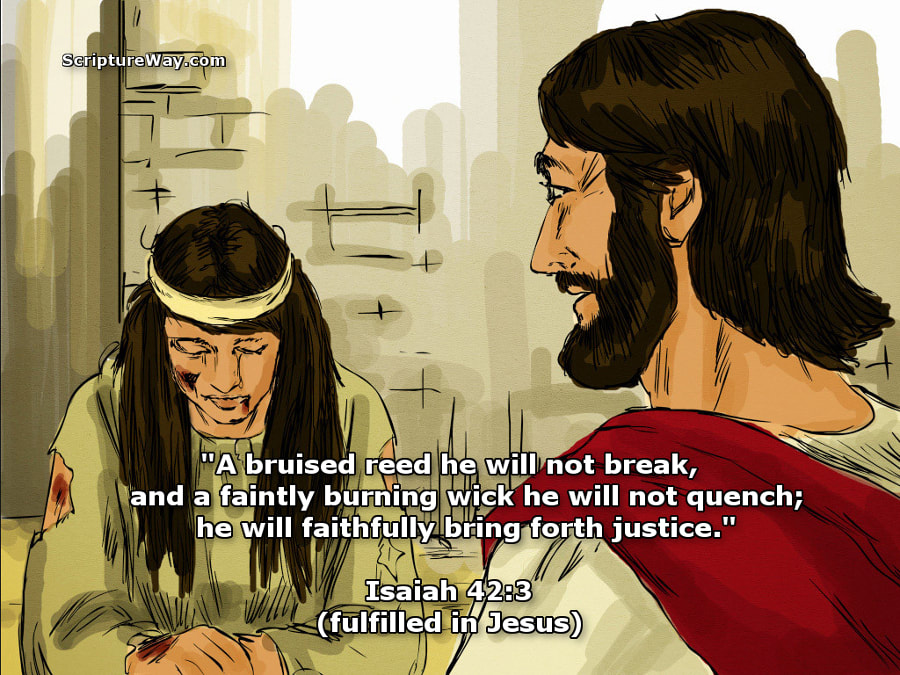 "And Jesus said, 'Neither do I condemn you; go, and from now on sin no more.'" (John 8:11) "And Jesus said, 'Neither do I condemn you; go, and from now on sin no more.'" (John 8:11)
"A bruised reed he will not break, and a faintly burning wick he will not quench; he will faithfully bring forth justice." (Isaiah 42:3)
"A bruised reed he will not break, and a smoldering wick he will not quench, until he brings justice to victory." (Matthew 12:20)
This lesson explains the meaning of the three phrases from Isaiah 42:3 -- "A bruised reed he will not break," "A faintly burning wick he will not quench," and "He will bring forth justice" which Matthew quoted in Matthew 12:20.
Consider. Are you a "bruised reed" (emotionally, spiritually, physically) needing the mending of Jesus? Come to him. Jesus specializes in mending broken lives.
The Bible verse quotations in this lesson are taken from the English Standard version (ESV) unless noted otherwise (Ref. 1).
1. "A bruised reed he will not break"
Jesus, our Savior, mends broken lives. Instead of "breaking" (or discarding) people who are weak morally, physically, or spiritually, Jesus strengthens them and binds them up (Ref. 2). Instead of dealing roughly with us when we come to him in our weakness, Jesus is tender and uses all gentleness and kindness toward us.
Example
Consider the account of the woman caught in adultery (the "bruised reed" in this example). The scribes and Pharisees brought her to Jesus seeking to stone her to death (John 8:1-11). Jesus made the woman's accusers realize their own sinful condition, and the scribes and Pharisees left the scene without casting a stone at the woman (John 8:5-9). Then, without condemning her or further "breaking" her, Jesus spoke with her tenderly as follows. "'Woman, where are they? Has no one condemned you?' She said, 'No one, Lord.' And Jesus said, 'Neither do I condemn you; go, and from now on sin no more'" (John 8:10-11).
Biblical Background
The prophet Isaiah, writing several hundred years before Christ, prophesied about the Servant who was to come (Isaiah 42:1-4). In Isaiah 42:1, God says "I have put my Spirit upon him." This prophecy was fulfilled at Jesus' baptism (Matthew 3:16-17). In Isaiah 42:3, the prophet says, "A bruised reed he will not break, and a faintly burning wick he will not quench; he will faithfully bring forth justice."
Matthew, the disciple of Jesus and the gospel writer, witnessed Jesus and his ministry. In Matthew 12:17, Matthew observed that Jesus fulfilled Isaiah's prophecy in Isaiah 42:1-4. In Matthew 12:18-21, Matthew quotes (and in places paraphrases) Isaiah 42:1-4. When Matthew stated in Matthew 12:17 that Jesus fulfilled Isaiah's prophecy, Matthew had just witnessed Jesus healing and restoring the man with the withered right hand (Matthew 12:9-14, Luke 6:6-11). That man also was an example of a "bruised reed" that Jesus restored. After Jesus healed him, the man, who likely was a mason or plasterer by trade, could return to working with his hands again for a living instead of begging bread (Ref. 3, Ref. 4). Matthew also had observed that multitudes of people -- including Gentiles (non-Jews) -- came to Jesus, and Jesus healed them all (Matthew 12:15, Mark 3:7-8). Jesus' ministry of healing and restoring "bruised reeds" then and today was and is for all people. That is good news. Biblical Meaning of "Bruised Reed"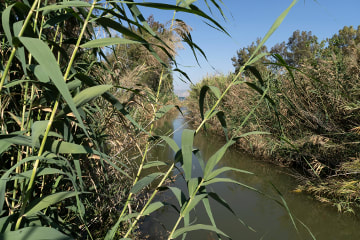 Reeds on the Side of the Jordan River Flowing into the Sea of Galilee - iStock Photo - Used under license Reeds on the Side of the Jordan River Flowing into the Sea of Galilee - iStock Photo - Used under license
Reeds are leafy cane plants that grow in watery or marshy areas. (See the picture of reeds near the Jordan river) (Ref. 5). However, scripture refers to reeds as fragile, weak, easily waved by the wind, easily broken, and unreliable when used as a staff (2 Kings 18:21, Matthew 11:7).
In Isaiah 42:3 the Hebrew word translated as "bruised" means broken or crushed but not entirely broken off (Ref. 6, Ref. 7). Thus, the words, "bruised reed," refer to a person who has been crushed or broken down by a sense of sin, by calamity, or by affliction (Ref. 7).
Good news
The good news is that Jesus Christ, the Messiah, does not break, consider useless, or discard people who are "bruised" emotionally, spiritually, or physically (Matthew 12:20). Instead, Jesus forgives our sins, tenderly binds up our wounds, and cares for us. Consider the multitudes of people who came to Jesus. The scripture says, "And many followed him, and he healed them all" (Matthew 12:15).
Similar verses
"The Lord is near to the brokenhearted and saves the crushed in spirit." (Psalm 34:18)
"He heals the brokenhearted and binds up their wounds." (Psalm 147:3) 2. "A faintly burning wick he will not quench"
When Jesus encounters people whose faith has dimmed or who have lost hope because of the hard knocks of life, Jesus does not ignore, discard, or "extinguish" us. Jesus nourishes the feeble flame, and rekindles our faith so his light in us shines brightly again.
Example
Consider the example of the man whose son had an unclean spirit which made his son mute, seized him, and threw him down in convulsions (Mark 9:14-29). The man is an example of a "smoldering wick" whose faith was dimming from the long-term afflictions of his son. The boy's father explained to Jesus that he had brought his son to Jesus' disciples, and they were not able to cast out the unclean spirit (Mark 9:18). That must have been terribly disappointing. Jesus asked that the boy be brought to him (Mark 9:19). When the boy was brought to Jesus, the unclean spirit -- seeing Jesus -- immediately threw the boy into convulsions (Mark 9:20).
The man's despair and weak faith is evident in the next verses. Jesus asked the boy's father, "How long has this been happening to him?" And he said, "From childhood. And it has often cast him into fire and into water, to destroy him. But if you can do anything, have compassion on us and help us" (Mark 9:21-22). "And Jesus said to him, 'If you can'! All things are possible for one who believes'" (Mark 9:23). "Immediately the father of the child cried out and said, 'I believe; help my unbelief!'" (Mark 9:24). Note that the man cried out to Jesus in his despair and asked Jesus to help him believe. Jesus answered the man's plea. Jesus rekindled the faith of this man who was a "faintly burning wick." Jesus commanded the unclean spirit to come out of the man's son, and the boy arose -- healed (Mark 9:25, 27). A smoldering wick (or smoking flax)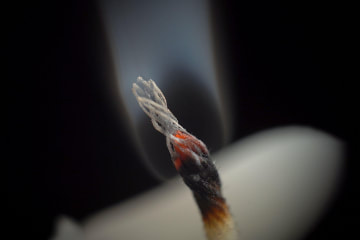 Close-up of a smoldering wick - Alamy photo - Used under license Close-up of a smoldering wick - Alamy photo - Used under license
A smoldering or faintly burning wick of a lamp is just barely burning before the fuel runs out (Matthew 25:8). The King James Version in both Isaiah 42:3 (KJV) and Matthew 12:20 (KJV) refers to the faintly burning or smoldering wick as "smoking flax." In ancient lamps, the wick was a few strands of flax fiber or twisted cotton thread (Ref. 8).
The Good News
Jesus does not give up on us or chastise us when our faith becomes weak because of the calamities of life. Jesus cherishes the feeble flame, ministers to us the "oil" of grace, and through the Holy Spirit, rekindles our faith in him.
Example verses
"Let your light shine before others, so that they may see your good works and give glory to your Father who is in heaven." (Matthew 5:16).
"My grace is sufficient for you, for my power is made perfect in weakness." (2 Corinthians 12:9) 3. "He will faithfully bring forth justice"
Jesus, the Servant prophesied by Isaiah, brought forth [proclaimed], and through his followers today still proclaims the Gospel truth -- God's good news of salvation through faith in Christ -- to all people (Isaiah 42:1, Matthew 12:18, Ref. 9). In Isaiah 42:3, the justice [judgment] that the Servant would bring forth refers to the entire system of God's truth (Psalm 19:9-10 NASB, Psalm 119:160 NASB, Ref. 10, Ref. 11).
Note that Isaiah prophesied that the Servant would spread justice [God's system of truth] not just to the Jewish people, but to the "nations" [all races, all people] (Isaiah 42:1, Matthew 12:17-18, Ref. 11, Ref. 12). Through Christ, the Christian gospel -- God's truth -- is being preached and taught by Jesus' followers throughout the world today (Matthew 28:19-20, Mark 16:15-16).
Apply. Are you a "bruised reed" (morally, physically, emotionally, or spiritually weak) needing the mending of Jesus? Come to Jesus now. In prayer, tell him your needs. Jesus will forgive your sins, and he will mend your broken life.
Are you a "faintly burning wick" with faith or hope that is nearly extinguished by affliction or by the calamities of life? Put your faith and trust in Jesus again. Jesus will supply the "oil" of his grace to rekindle your faith into a bright flame that will shine and bless others.
References
1. https://www.biblegateway.com/versions/English-Standard-Version-ESV-Bible/ 2. https://biblehub.com/commentaries/poole/isaiah/42.htm Matthew Poole's Commentary - Isaiah 42:3 3. https://en.wikipedia.org/wiki/Healing_the_man_with_a_withered_hand 4. https://biblehub.com/commentaries/gill/matthew/12.htm Gill's Exposition of the Entire Bible - Matthew 12:10 5. https://biblehub.com/hebrew/7070.htm 6. https://biblehub.com/hebrew/7533.htm 7. https://biblehub.com/commentaries/barnes/isaiah/42.htm Barnes' Notes on the Bible - Isaiah 42:3 8. https://www.gotquestions.org/smoking-flax-not-quench.html 9. https://biblehub.com/greek/518.htm Note, the Greek word for "proclaim" in Matthew 12:18 10. https://biblehub.com/hebrew/4941.htm 11. https://biblehub.com/commentaries/barnes/matthew/12.htm Barnes' Notes on the Bible - Matthew 12:18 12. https://biblehub.com/greek/1484.htm
0 Comments
|
Daily Bible Verse(Click the link above) AuthorMr. Whitney V. Myers. Christian. For more information, please visit the Author Page. Posting ScheduleI plan to provide new postings about once a month. Planned Topics(subject to change) Recent Posts(most recent three months) Popular Posts(top 10) Categories
All
Archives
July 2024
|
 RSS Feed
|
The ScriptureWay site provides Bible Teachings that point to Jesus. The Bible teaches that believing in Jesus Christ is the only way to heaven.
"I am the way, and the truth, and the life; no one comes to the Father but through Me." -- Jesus speaking in John 14:6 
|
|
|
Copyright 2018-2024 Whitney V. Myers |
Listed in Feedspot's Top 100 Bible Study Blogs and Websites |