Photo Copyright: kyrien
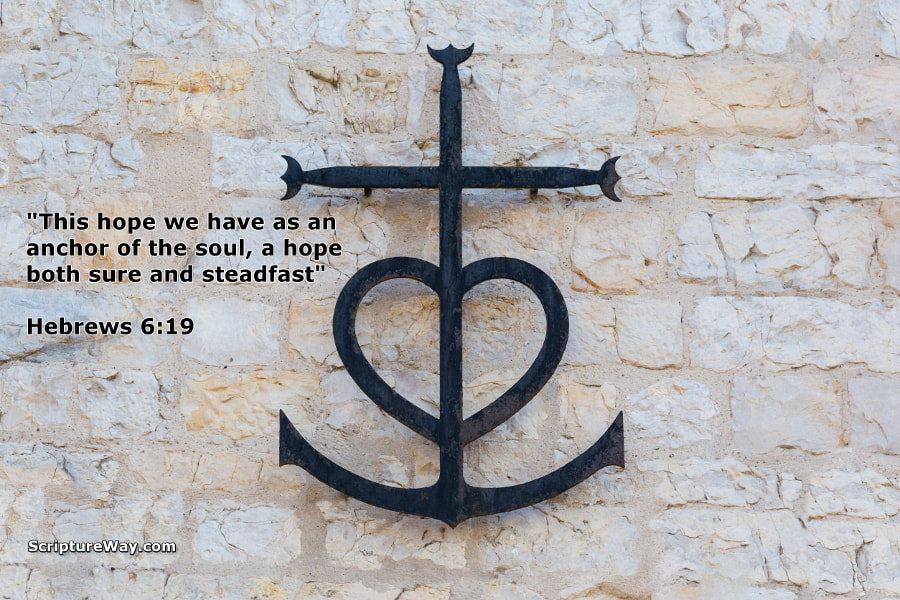
Camargue Cross - Faith, Hope, and Love - Saintes Maries de la Mer (St. Mary's of the Sea), France - Hebrews 6:19 - 123RF Photo - Used under license
"This hope we have as an anchor of the soul, a hope both sure and steadfast and one which enters within the veil." (Hebrews 6:19)
"When all around my soul gives way, he then is all my hope and stay." -- Edward Mote (1797-1874), writer of the hymn, "My Hope is Built" (Ref. 1, Ref. 2).
Consider. When the storms of life come, in whom or in what is your soul secure, even when tossed by waves of trouble, grief, or loss? What is the anchor for your soul?
Hope Is an Anchor for the Soul
"This hope [this confident assurance] we have as an anchor of the soul [it cannot slip and it cannot break down under whatever pressure bears upon it]—a safe and steadfast hope that enters within the veil [of the heavenly temple, that most Holy Place in which the very presence of God dwells]." (Hebrews 6:19 AMP)
For believers in Jesus Christ, our hope -- our expectation for the future and our confident assurance for the present -- is an anchor for our soul (Hebrews 6:19). Hope accomplishes for our soul the same thing an anchor does for a ship (Ref. 3). In the same way that an anchor holds a ship sure and steadfast through a storm, our hope of heaven and eternal life with Christ holds us firmly and keeps us calm through the difficult storms of life. Our hope of heaven and eternal life with Christ cannot slip and it cannot break down under whatever pressure bears upon it (Hebrews 6:19 AMP). Edward Mote referred to Christ and to hope when he wrote the hymn line, "When all around my soul gives way, he then is all my hope and stay" (Ref. 1, Ref. 2).
Which enters within the veil
The writer of Hebrews adds that this hope set before us is "one which enters within the veil" (Hebrews 6:19). The Amplified Bible describes the veil as "the heavenly temple, that most Holy Place in which the very presence of God dwells" (Hebrews 6:19 AMP).
Recall that under the Old Testament system, the Most Holy Place, the innermost and most sacred place in the tabernacle and later the temple, was separated from the Holy Place by a veil (a curtain) (Exodus 26:31-33, 1 Kings 6:14-19, Hebrews 9:3). The Most Holy Place contained the ark of the covenant which was the symbol for the presence of God (1 Kings 8:6, 10-11). Only one person, the high priest, entered the Most Holy Place one day a year taking blood to atone for the sins of himself and the people (Hebrews 9:3, 6-7). During Jesus' earthly life, he did not enter the Most Holy Place in the human-made temple in Jerusalem. However, when Jesus Christ, the Messiah, the Son of God died sacrificially to atone for our sins, the veil of the temple was torn in two from top to bottom (Mark 15:37-39). Jesus Christ gained direct access for us to the holy place in heaven, the presence of God (Hebrews 9:24, Hebrews 10:19-21). Now, as believers in Christ, our hope has entered within the veil and is surely anchored in heaven, in the presence of God. Edward Mote wrote the hymn line, "In every high and stormy gale, my anchor holds within the veil" (Ref. 1, Ref. 2). A Living Hope (1 Peter 1:3)
"Blessed be the God and Father of our Lord Jesus Christ, who according to His great mercy has caused us to be born again to a living hope through the resurrection of Jesus Christ from the dead" (1 Peter 1:3).
Without the resurrection of Jesus Christ, there would be no anchor for our soul -- no hope, no eternal life. However, because of God's great mercy, and because of the death and resurrection of Jesus Christ, we do have an anchor for our soul. God has given us a secure living hope through believing in his Son and in his resurrection (John 11:25-26, 1 Peter 1:3). Jesus said to Martha, "I am the resurrection and the life; the one who believes in Me will live, even if he dies, and everyone who lives and believes in Me will never die. Do you believe this?" (John 11:25-26). A Hope that Abounds (Romans 15:13)
"Now may the God of hope fill you with all joy and peace in believing, so that you will abound in hope by the power of the Holy Spirit" (Romans 15:13).
The Apostle Paul prays for us as believers that God will fill us with joy and peace not just that we will have hope, but that we will abound in hope (Romans 15:13). The Greek word for abound means to overflow beyond measure (Ref. 4). The power of the Holy Spirit fills us with joy and peace, and our hope does abound -- a full assurance of hope until the end (Hebrews 6:11). Our abounding hope in Christ and eternal life is the anchor for our soul that keeps us steady and calm through the storms and trials of life.
Apply. Through whatever storm or trial you are going through, Jesus Christ and his gift of eternal life is your hope, the hope that is an anchor for your soul. Trust him, believe him, have confidence in him. Ask him to fill you with joy and peace by the power of the Holy Spirit so that your hope abounds, overflows without measure, and keeps you steady and calm, with full assurance of hope until the day you are with him in heaven.
Related Lessons
"What is Eternal Life?" (John 17:3) "Jesus is the Resurrection and the Life (Job's Question, Jesus' Answer)" (Job 14:14, John 11:25-26)
3 Comments
Woman Praising God - Ephesians 2:4-5 - 123RF Photo - Used under license
"But God, being rich in mercy, because of the great love with which he loved us, even when we were dead in our trespasses, made us alive together with Christ—by grace you have been saved." (Ephesians 2:4-5)
God has made believers in Christ alive together with Christ. We identify with the resurrection of Christ, and God gives us a new quality of life -- eternal life.
Consider. If you are a believer in Christ, how would you describe to an inquisitive unbeliever or a new believer what it means to be "made alive together with Christ"?
1. Who is Paul writing to?
Paul begins his letter, "Paul, an apostle of Christ Jesus by the will of God, to the saints who are in Ephesus, and are faithful in Christ Jesus:" (Ephesians 1:1). The Greek word for saints is hagios (hag'-ee-os) which means different or holy. Christians are different from the world because we are like the Lord (Ref. 1). Clearly, Paul is writing to believers in Jesus Christ.
2. What was the former spiritual condition of the Ephesian believers before God made them alive together with Christ?
Paul writes, "And you were dead in the trespasses and sins in which you once walked, following the course of this world ..." (Ephesians 2:1-2). In the same way, without Christ, we were dead in our trespasses and sins. We inherited our spiritual "deadness" from Adam (Genesis 2:16-17, Genesis 3:6). Romans 5:12 says, "When Adam sinned, sin entered the world. Adam’s sin brought death, so death spread to everyone, for everyone sinned" (Romans 5:12 NLT).
Trespasses are a lapse or deviation from the truth, a slip-up, or an error that can be unintentional or willful (Ref. 2). Sins are thoughts, words, or deeds where we miss the mark or target (Ref. 3). 3. Even when we were dead in our trespasses and sins, before we were in Christ, God loved us.
God's divine attributes of mercy and love moved God to plan for and provide for our salvation (Ephesians 1:3-5, Ephesians 2:4-5, Colossians 2:13-14). Romans 5:8 tells us, "But God shows his love for us in that while we were still sinners, Christ died for us." Jesus said about himself, "For God so loved the world, that he gave his only Son, that whoever believes in him should not perish but have eternal life. For God did not send his Son into the world to condemn the world, but in order that the world might be saved through him" (John 3:16-17).
4. Together with Christ, God has made us alive.
Ephesians 2:5 tells us (believers) that God has made us alive together with Christ. In the Greek, the verb does not just say "made alive." It says, "made alive together with" (Ref. 4). Strong's Exhaustive Concordance defines this verb, suzóopoieó (sood-zo-op-oy-eh'-o), as "to reanimate conjointly with, (figuratively) -- quicken together with." As believers in Christ, we identify with and are co-joined with Christ in his resurrection. Paul writes, "If you confess with your mouth that Jesus is Lord and believe in your heart that God raised him from the dead, you will be saved" (Romans 10:9).
5. When God makes us alive together with Christ, God gives us a new quality of life -- eternal life.
When we believe in Jesus Christ and in his resurrection, God makes us alive together with Christ. God gives us a new quality of life -- eternal life (Romans 6:23). Eternal life begins for the believer when they put their faith and trust in Christ, and continues after their physical death (John 11:25-26, Ref. 6).
Being made alive in Christ results in a new quality of life. The Greek word for eternal in eternal life is aiónios, which means perpetual, unending, age-long (Strong's Concordance, Ref. 5, Ref. 6). Aiónios includes the character of that which lasts for an age, as contrasted with that which is brief and fleeting (Ref. 5, Ref. 6). "Aiónios does not focus on the future per se, but rather on the quality of the age it relates to. People who are alive spiritually in Christ live in eternal life right now, experiencing this quality of God's life now as a present possession" (Helps Word-studies, Ref. 5, Ref. 6).
Apply. If you already are a believer in Jesus Christ, praise God that God has made you spiritually alive together with Christ. Thank God for the quality of new life that he has given you in Christ. If you are not yet a believer in Jesus Christ, put your faith and trust in him today. He will forgive your trespasses and sins. He will make you spiritually alive together with himself, and he will give you a new quality of life -- eternal life.
Related Lessons
"What is Eternal Life?" (John 17:3) "Jesus is the Resurrection and the Life (Job's Question, Jesus' Answer)" (Job 14:14, John 11:25-26) "Jesus Christ is the Life - John 14:6" "Jesus is the Way to Heaven" (John 14:6)
References
1. https://biblehub.com/greek/40.htm 2. https://biblehub.com/greek/3900.htm 3. https://biblehub.com/greek/266.htm 4. https://biblehub.com/greek/4806.htm 5. https://biblehub.com/greek/166.htm 6. http://www.scriptureway.com/home/what-is-eternal-life
Updated 3 July 2024
Photo source: FreeBibleImages.org
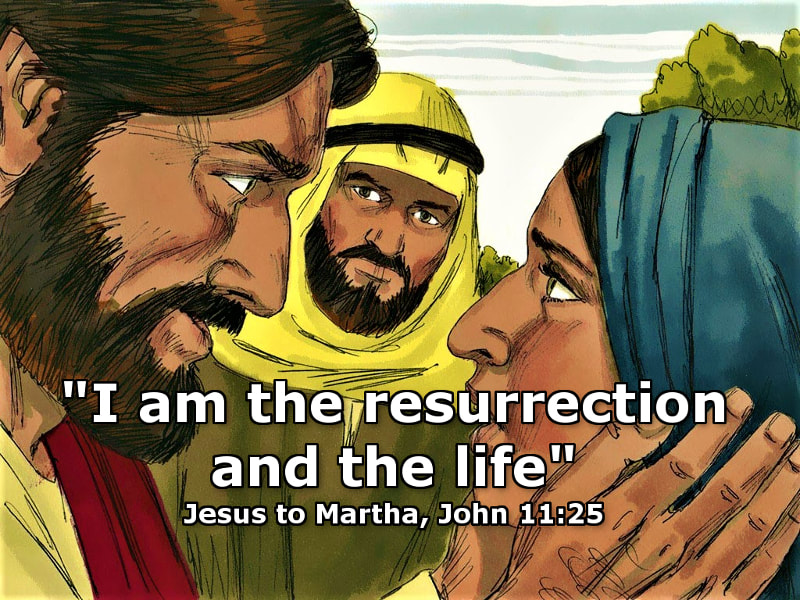
Jesus says to Martha, "I am the resurrection and the life; he who believes in Me shall live even if he dies" (John 11:25)
"Jesus said to her, 'I am the resurrection and the life; he who believes in Me will live even if he dies, and everyone who lives and believes in Me will never die. Do you believe this?' " (John 11:25-26)
Consider. Do you believe in Jesus, and do you believe that you will live in him even after your physical death?
This lesson discusses Job's question, "If a man dies, will he live again?," (Job 14:14), and Jesus' answer, "I am the resurrection and the life; he who believes in Me will live even if he dies" (John 11:25).
The scriptures quoted in this lesson are from the New American Standard Bible, 1995 version, unless noted otherwise (Ref. 1).
Job's Question - "If a man dies, will he live again?"
Job asked, "If a man dies, will he live again? All the days of my struggle I will wait until my change comes" (Job 14:14). Job looked forward to a future time when he would be changed and revived from death. The Hebrew word for change in Job 14:14 is chaliphah (pronounced as khal-ee-faw'). Chaliphah means a change of garments (Genesis 45:21-22) as well as revival after death (Job 14:14, Ref. 2).
Job also believed that in a future time in the flesh he would see God. "As for me, I know that my Redeemer lives, and at the last He will take His stand on the earth. Even after my skin is destroyed, Yet from my flesh I shall see God" (Job 19:25-26). Jesus' Answer - "I Am the Resurrection and the Life"
John, the disciple of Jesus, wrote in John 11:1-5 about Jesus receiving news his friend Lazarus was sick. Jesus waited two more days (John 11:6), and then he took his disciples to Bethany, the village of Mary, Martha, and Lazarus (John 11:1). Jesus knew before he traveled to Bethany that Lazarus already was dead (John 11:14).
When Jesus came to Bethany, Martha came out to meet him (John 11:20). Martha said to Jesus, "Lord, if You had been here, my brother would not have died" (John 11:21). Jesus assured her, "Your brother will rise again" (John 11:23). Martha replied to Jesus, "I know that he will rise again in the resurrection on the last day" (John 11:24). The Greek word for resurrection in John 11:24-25 is anastasis (pronounced as an-as'-tas-is), which means standing up again, referring to physical resurrection of the body (Ref. 3). Note that Martha believed in a resurrection - as a future event. Believe in Jesus - Receive Eternal Life
Jesus then turned his discussion with Martha to the present. Jesus told Martha, and these words assure us today -- "I am the resurrection and the life; he who believes in Me will live even if he dies, and everyone who lives and believes in Me will never die. Do you believe this?" (John 11:25-26).
Job's question was, "If a man dies, will he live again?" (Job 14:14). Jesus answered Job's question in the affirmative (yes) and with a promise. Jesus' promise is that when you believe in (trust in, have faith in) him you will live even after your physical death (Ref. 4). Jesus is referring to the eternal life of our soul and spirit which begins during this earthly life when we believe in him, and that eternal life continues with Jesus after our physical death ("What is Eternal Life"- Ref. 5).
Apply. Jesus said to Martha, "I am the resurrection and the life; he who believes in Me will live even if he dies, and everyone who lives and believes in Me will never die" (John 11:25-26). Then Jesus asked Martha, "Do you believe this?" ... (pause) Do you believe this?
Related Lessons and Resources
"What is Eternal Life?" (John 17:3) "Bible Verses About Eternal Life" "Made Alive Together with Christ - A New Quality of Life" (Ephesians 2:45) "Paradise, Jesus, and the Penitent Thief" (Luke 23:42-43)
Sun and Clouds - Pixabay Stock Photo - with John 17:3 Added
"This is eternal life, that they may know You, the only true God, and Jesus Christ whom You have sent." (John 17:3)
"Life eternal, then, is not mere conscious and unending existence, but a life of acquaintance with God in Christ." (Jamieson-Fausset-Brown Bible Commentary, Ref. 1)
This lesson describes the biblical definition of eternal life. This lesson primarily uses the Scriptures about eternal life in the Gospel of John. In the next lesson in the series, we will focus on who receives eternal life and how to receive eternal life.
Consider. Think for a moment. How would you define eternal life? How would you explain eternal life to an inquisitive unbeliever, or to a new Christian? For believers in Christ, eternal life certainly includes living with God after our physical death (John 11:25-26). However, the Bible has much more to say about the characteristics of eternal life.
Eternal life is a free gift of God to believers in Jesus Christ.
The Apostle Paul states, "For the wages of sin is death, but the free gift of God is eternal life in Christ Jesus our Lord" (Romans 6:23). In this verse, the Greek word for gift is charisma. Charisma means a gift of grace, an undeserved favor (Ref. 2). Thus, eternal life is not something we deserve or earn. Eternal life is an undeserved gift of God's grace and favor. "In spite of your sanctification as Christians, still you will not have earned eternal life; it is the gift of God’s grace" (Ref. 3).
Jesus said, "My sheep hear My voice, and I know them, and they follow Me; and I give eternal life to them, and they will never perish; and no one will snatch them out of My hand" (John 10:27-28). For the believer, eternal life begins in the present, the here and now.
Jesus described eternal life in the present tense. Thus, eternal life is not just in the future, but is a present possession of the believer which continues into the future.
John 3:36 - "He who believes in the Son has eternal life; but he who does not obey the Son will not see life, but the wrath of God abides on him." John 5:24 - "Truly, truly, I say to you, he who hears My word, and believes Him who sent Me, has eternal life, and does not come into judgment, but has passed out of death into life. John 6:47 - "Truly, truly, I say to you, he who believes has eternal life." In John 5:24, note the importance of hearing Jesus' words. Jesus said, "He who hears My word, and believes Him who sent Me, has eternal life." For believers in Christ, eternal life continues with God after our physical death.
Jesus said to Martha, "I am the resurrection and the life; he who believes in Me will live even if he dies, and everyone who lives and believes in Me will never die. Do you believe this?" (John 11:25-26).
To the thief on the cross who asked Jesus to remember him, Jesus said, "Truly I say to you, today you shall be with Me in Paradise" (Luke 23:42-43). Jesus said to his disciples, "In My Father’s house are many dwelling places; if it were not so, I would have told you; for I go to prepare a place for you. If I go and prepare a place for you, I will come again and receive you to Myself, that where I am, there you may be also" (John 14:2-3). Jesus defined eternal life as knowing God experientially.
"Jesus spoke these things; and lifting up His eyes to heaven, He said, 'Father, the hour has come; glorify Your Son, that the Son may glorify You, even as You gave Him authority over all flesh, that to all whom You have given Him, He may give eternal life. This is eternal life, that they may know You, the only true God, and Jesus Christ whom You have sent" (John 17:1-3).
In John 17:3, the Greek word for know is ginóskó. Ginóskó means to know, especially through personal experience (first-hand acquaintance) (HELPS Word-studies, Ref. 4). Knowing God experientially requires knowing Jesus who is the truth (John 14:6), as well as knowing and living the Word of God on a daily and life-long basis. "This life eternal, then, is not mere conscious and unending existence, but a life of acquaintance with God in Christ" (Ref. 1). Eternal life is a quality of life, not just the duration of life.
The Greek word for eternal is aiónios, which means perpetual, unending, age-long (Strong's Concordance, Ref. 5). Aiónios includes the character of that which lasts for an age, as contrasted with that which is brief and fleeting (Ref. 5). "Aiónios does not focus on the future per se, but rather on the quality of the age it relates to. Thus, believers live in eternal life right now, experiencing this quality of God's life now as a present possession" (Helps Word-studies, Ref. 5).
Summary. Eternal life is a free gift of God to those who believe in Jesus Christ. Eternal life begins when we put our faith in Jesus. As believers in Christ, eternal life continues with God after our physical death. Eternal life is the quality of life that results when we know Jesus Christ by experience, on a first-hand basis.
Apply. Think for a moment. In your own words, how would you describe eternal life? Write down your description of eternal life in a few sentences. What Scripture verse would be your key reference?
Related Lessons
"Paradise, Jesus, and the Penitent Thief" (Luke 23:42-43) "What is the Tree of Life in the Bible?" (Genesis 2:9, Revelation 2:7) "Made Alive Together with Christ - A New Quality of Life" (Ephesians 2:4-5) "Jesus is the Resurrection and the Life (Job's Question, Jesus' Answer)" (Job 14:14, John 11:25-26) |
Daily Bible Verse(Click the link above) AuthorMr. Whitney V. Myers. Christian. For more information, please visit the Author Page. Posting ScheduleI plan to provide new postings about once a month. Planned Topics(subject to change) Recent Posts(most recent three months) Popular Posts(top 10) Categories
All
Archives
July 2024
|
 RSS Feed
|
The ScriptureWay site provides Bible Teachings that point to Jesus. The Bible teaches that believing in Jesus Christ is the only way to heaven.
"I am the way, and the truth, and the life; no one comes to the Father but through Me." -- Jesus speaking in John 14:6 
|
|
|
Copyright 2018-2024 Whitney V. Myers |
Listed in Feedspot's Top 100 Bible Study Blogs and Websites |