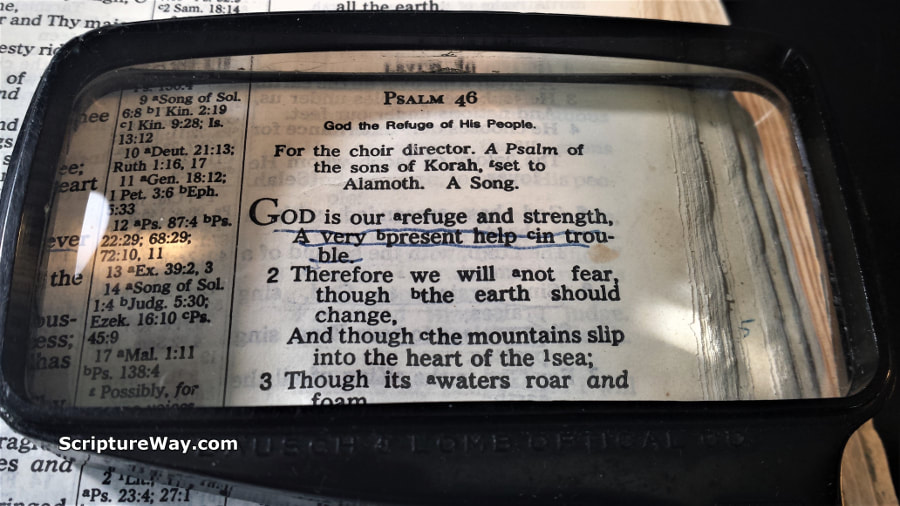
God is Our Refuge, Strength, and Help - Psalm 46:1 - Photo by Whitney V. Myers
Consider. Do you need God's help and strength for what you are facing today? How can you better experience God's protection as your refuge?
God is Our Refuge
The Bible tells us that God is our place of safety and protection from danger and distress. A refuge is a place where we go, and while we are inside, we are protected because our refuge surrounds us as our defense. David writes, "For You have been a refuge for me, A tower of strength against the enemy" (Psalm 61:3). Solomon writes, "The name of the Lord is a strong tower; The righteous runs into it and is safe" (Proverbs 18:10). David tells us from his own experience, "The angel of the Lord encamps around those who fear him, and delivers them" (Psalm 34:7, italics added).
The Bible provides several clear images for God as our refuge - a tower that we run into (Psalm 61:3, Proverbs 18:10), our shelter from the storm (Isaiah 25:4), our rock and fortress (Psalm 18:2), our shield (Psalm 28:7), and our hiding place (Psalm 32:7).
God is Our Strength
Note that Psalm 46:1 does not just say "God is strong" (which he is). This scripture verse says that God is our strength. We who are God's people can receive, experience, and apply God's strength to face our enemies such as worry, fear, discouragement, and opposition. God gives us the strength to accomplish the work he gives us to do in the face of these enemies.
The Apostle Paul knew that God was his strength. Paul wrote during his imprisonment, "I can do all things through Christ who strengthens me" (Philippians 4:13). God provides strength to the believer to accomplish what God gives the believer faith to do (1 John 5:4). As believers, we need God's strength when we encounter resistance and trials. God provides us that strength. Hymn composer Will L. Thompson (1847-1909) writes, "Jesus is all the world to me, My life, my joy, my all; He is my strength from day to day, Without him I would fall" (Ref. 1). David writes, "The Lord is my strength and my shield; in him my heart trusts, and I am helped; my heart exults, and with my song I give thanks to him" (Psalm 28:7). God is a Very Present (Proven) Help in Trouble
The word for help means aid, assistance (Ref. 2, Ref. 3). The word translated as present means proven to be (Ref. 4), that is, God is proven to be our help in trouble. The word very means exceedingly, emphasizing that this statement is true (Ref. 5, Ref. 6). Because God is proven to be our help in trouble, we have nothing to fear (Psalm 46:2).
David writes, "For you have been my help, and in the shadow of your wings I will sing for joy" (Psalm 63:7). The writer of Hebrews states, "The Lord is my helper; I will not fear; what can man do to me?" (Hebrews 13:6).
Summary. Let's review the main principles in this lesson.
1. God is our "go to" place for refuge, safety, and protection from danger. God surrounds us as our defense. 2. God is our source of strength to face our enemies and to do the work he gives us to do. 3. God is proven to be our help in trouble, and we have nothing to fear, repeat, we have nothing to fear.
Apply. Take time now to pray. Thank God for being your refuge - your protection, your place of safety. Ask God to give you strength and faith to face your enemies and to do the work that God has given you to do. Thank God that because of him you have nothing to fear.
Listen to/Watch Video. "A Mighty Fortress" sung by HeartSong - Cedarville University, Cedarville, Ohio, USA.
References
1. https://hymnary.org/text/jesus_is_all_the_world_to_me_my_life_my 2. https://biblehub.com/hebrew/5833.htm 3. https://www.merriam-webster.com/dictionary/help 4. https://biblehub.com/hebrew/4672.htm 5. https://biblehub.com/commentaries/barnes/psalms/46.htm 6. https://biblehub.com/hebrew/3966.htm
4 Comments
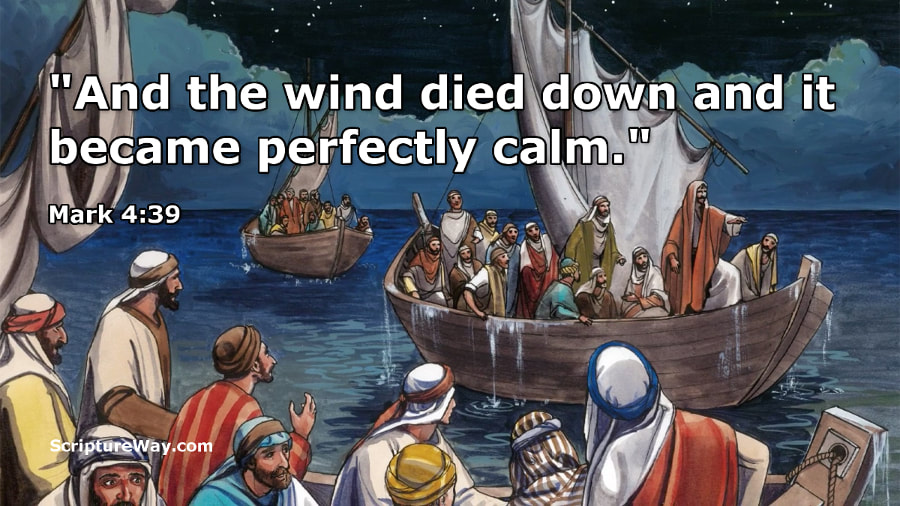 Jesus Calms the Storm - Mark 4:39 - Used by permission - Good News Productions International and College Press Publishing "And there arose a fierce gale of wind, and the waves were breaking over the boat so much that the boat was already filling up. Jesus Himself was in the stern, asleep on the cushion; and they woke Him and said to Him, 'Teacher, do You not care that we are perishing?' And He got up and rebuked the wind and said to the sea, 'Hush, be still.' And the wind died down and it became perfectly calm. And He said to them, 'Why are you afraid? Do you still have no faith?' They became very much afraid and said to one another, 'Who then is this, that even the wind and the sea obey Him?' " (Mark 4:37-41) "When the storms of life are raging, Stand by me (stand by me); When the storms of life are raging, Stand by me (stand by me); When the world is tossing me Like a ship upon the sea Thou who rulest wind and water, Stand by me (stand by me)." -- Charles Albert Tindley, 1905 This article describes the background and scripture allusions for the gospel hymn, "Stand by Me," by Rev. Dr. Charles A. Tindley. Consider. Are you going through a personal storm today? The same Jesus who rebuked the wind and said to the sea, "Hush, be still," can calm your personal storms. 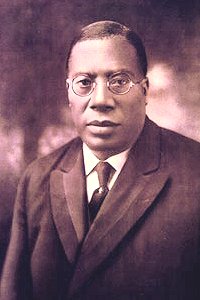 Rev. Dr. Charles A. Tindley (Ref. 2) Rev. Dr. Charles A. Tindley (Ref. 2) Hymn Author and Composer. The Reverend Dr. Charles Albert Tindley (1851-1933) was an American Methodist minister and was one of the founding fathers of American gospel music (Ref. 1, Ref. 2). He was the son of a slave, and he taught himself to read and write. After the American Civil War he moved to Philadelphia as a young person where he found employment as a hod carrier (brick carrier) (Ref. 1). He and his wife Daisy attended the Bainbridge Street Methodist Episcopal Church in Philadelphia where Charles became the sexton (janitor) (Ref. 1, Ref. 3). Tindley was never able to go to school (Ref. 1). He was self-taught, never graduating from college or seminary, yet he acquired and read more than 8,000 books (Ref. 4). Tindley learned Hebrew through the help of a Philadelphia synagogue, and he learned Greek by taking a correspondence course through the Boston Theological School. Tindley qualified for ordination in the Methodist Episcopal Church by examination (Ref. 1). After serving churches in Delaware, New Jersey, and Maryland, Tindley later became the pastor at the same church in Philadelphia where he had been a janitor (Ref. 1, Ref. 4). Under his leadership and powerful preaching, the multi-racial congregation grew from 130 members to more than 10,000 members (Ref. 1, Ref. 3). Tindley was awarded honorary Doctor of Divinity degrees by Bennett College (North Carolina) and Morgan College (Maryland) (Ref. 1). Life was not easy for people in the northeastern United States at the turn of the 20th century. The area near Tindley's church was economically depressed, especially for African Americans during this time (Ref. 4). The hymn "Stand By Me" speaks to the difficulties that many of Tindley's parishioners faced (Ref. 4). Charles A. Tindley composed and published over 40 gospel songs (Ref. 1, Ref. 2). His best-known gospel songs include "Stand by Me" (Ref. 5), "Leave it There" (Ref. 6), and "We'll Understand It Better By and By" (Ref. 7). His song, "I’ll Overcome Some Day" (Ref. 8) was the basis for the American civil rights anthem "We Shall Overcome," popularized in the 1960s (Ref. 2). "Stand By Me" Scripture Allusions. Below I describe several phrases from the "Stand by Me" hymn text and their scripture allusions. To see the complete set of all five verses of the hymn text, please click either on the attached lyric sheet or hymn sheet.
Listen. The music for "Stand By Me" will encourage you. Watch one or both of the music videos below.
Apply. Thank Jesus for the times he has stood by you during the challenges you have faced in life. Ask Jesus to stand by you, to give you strength and courage, and to calm the storm you are going through today. References
1. https://en.wikipedia.org/wiki/Charles_Albert_Tindley 2. http://www.hymntime.com/tch/bio/t/i/n/tindley_ca.htm 3. http://www.dubois-theward.org/history/congregations/tindley-temple/ 4. https://www.umcdiscipleship.org/resources/history-of-hymns-stand-by-me 5. http://www.hymntime.com/tch/htm/s/t/a/n/standbym.htm 6. http://www.hymntime.com/tch/htm/l/e/a/v/leaveitt.htm 7. http://www.hymntime.com/tch/htm/w/e/l/u/welunder.htm 8. http://www.hymntime.com/tch/htm/i/l/l/o/illoverc.htm 9. https://biblehub.com/commentaries/benson/2_timothy/4.htm |
Daily Bible Verse(Click the link above) AuthorMr. Whitney V. Myers. Christian. For more information, please visit the Author Page. Posting ScheduleI plan to provide new postings about once a month. Planned Topics(subject to change) Recent Posts(most recent three months) Popular Posts(top 10) Categories
All
Archives
July 2024
|
 RSS Feed
|
The ScriptureWay site provides Bible Teachings that point to Jesus. The Bible teaches that believing in Jesus Christ is the only way to heaven.
"I am the way, and the truth, and the life; no one comes to the Father but through Me." -- Jesus speaking in John 14:6 
|
|
|
Copyright 2018-2024 Whitney V. Myers |
Listed in Feedspot's Top 100 Bible Study Blogs and Websites |