"Take my yoke upon you and learn from me, for I am gentle and humble in heart, and you will find rest for your souls." (Matthew 11:29)
The expression, "You will find rest for your souls" occurs only twice in the Bible, in Jeremiah 6:16 and Matthew 11:29. This lesson explains how rest for our souls is found according to the Bible.
The scripture quotations in this lesson are taken from the New International Version (NIV) unless noted otherwise (Ref. 1).
Consider. According to the Bible, how does a person find rest for their soul?
1. Rest for our souls is found where God's ancient, good way is honored.
"This is what the Lord says: 'Stand at the crossroads and look; ask for the ancient paths, ask where the good way is, and walk in it, and you will find rest for your souls.' But you said, ‘We will not walk in it.'" (Jeremiah 6:16)
In Jeremiah 6:16, God promised the people of Jerusalem that they would find rest for their souls if they would walk in obedience to God's good way as God had instructed their ancestors. God's good way was expressed primarily in the Ten Commandments (Deuteronomy 5:1-21,
Deuteronomy 5:33). In Jeremiah 6:16, the promised "rest" in "rest for your souls" means inner peace and tranquility (Ref. 2, Ref. 3). This Hebrew word for "rest" in Jeremiah 6:16 occurs only once in the Old Testament (Ref. 2). Unfortunately, the people of Jerusalem chose to refuse God's instruction. Their ears were closed and the word of the Lord was offensive to them (Jeremiah 6:10). By choosing their own way, they did not find rest for their souls. By choosing their own way, they soon suffered siege and being carried away into captivity (2 Kings 24:10-14). 2. Jesus is the giver of rest to the weary and burdened.
In Matthew 11:28, we find the first part of Jesus' two-part summons. The first part of his summons is "Come to me." The second part, in Matthew 11:29, is "Take my yoke upon you and learn from me."
Jesus is the giver of true rest (Matthew 11:28). When we come to Jesus as he has already invited us, he gives us rest from our toil, and rest from our burdens. When we come to Jesus, he unburdens us by forgiving our sins and taking away our anxiety as we place our faith and trust in him (1 John 1:9, John 14:1). In Matthew 11:28, the rest that Jesus gives us is anapauó [pronounced, an-ap-ow'-o], which means refreshment (Ref. 4). The rest [refreshment] that Jesus gives from our anxiety, grief, and sin prepares us to enter (or re-enter) service to Jesus. By coming to Jesus, and only to Jesus, we find the peace, comfort, and forgiveness that we need (John 14:27, Matthew 5:4, 1 John 1:9). 3. Rest for our souls is found in submission to Jesus' gentle yoke.
"Take my yoke upon you and learn from me, for I am gentle and humble in heart, and you will find rest for your souls." (Matthew 11:29)
The surprise and main point for this lesson is that rest for our souls is found in submission to Jesus' gentle yoke. Jesus said we are to take his yoke upon us and learn from him, and we will find rest for our souls.
In Matthew 11:29, the Greek word for "rest" is anapausis [pronounced, ah-NAH-pow-sis] which means inner tranquility (Ref. 5). This definition for "rest" is similar to the rest the Lord promised we would find by walking in his good way (Jeremiah 6:16, Ref. 2). Jesus teaches that we find rest [tranquility] for our souls by responding to both parts of Jesus' two-part summons. First, we come to Jesus and he unburdens us by forgiving our sins and taking away our anxiety as we trust in him (Matthew 11:28, 1 John 1:9, John 14:1). Second, as Jesus promised, we find rest for our souls by taking on Jesus' yoke, and learning from him. Taking on Jesus' yoke and learning from him is not "one and done," but is a continuing spiritual process throughout our lifetime (Matthew 11:29). Rest for our souls is not found in escape from work and service but in submission to Christ for work and service. Let us then take on Jesus' yoke, learn from him, and serve him daily. Then we will find that his yoke is easy and his burden is light (Matthew 11:30).
Apply. Come to Jesus in prayer. Receive his forgiveness, and release your burdens to him. Take on his yoke by submitting your will to him, and learning from him. Ask him to direct you in the work and service he would have you do for others. Then you will find Jesus' promise -- rest for your soul.
Related Lessons
"The Way of the Lord (Old Testament)" - Deuteronomy 5:33 "Jesus' Invitation - Come to Me and Rest" - Matthew 11:28-29
References
1. https://www.biblegateway.com/versions/New-International-Version-NIV-Bible/ 2. https://biblehub.com/hebrew/4771.htm 3. https://www.merriam-webster.com/dictionary/repose 4. https://biblehub.com/greek/373.htm 5. https://biblehub.com/greek/372.htm
2 Comments
This lesson teaches that for believers in Jesus Christ, according to the Bible, our soul goes immediately to be with Jesus in heaven upon our death. This lesson also explains where the souls of the righteous and unrighteous have gone before and after the resurrection of Jesus Christ. This lesson concludes by discussing the final destiny for believers and the final destiny for unbelievers.
Scripture quotations in this lesson are taken from the New American Standard Bible (NASB) 2020 edition unless noted otherwise (Ref. 1). Consider. Where will your soul go when you die? Why? 1. At your physical death, your soul and spirit will depart from your body
"And it came about, as her soul was departing (for she died), that she named him Ben-oni; but his father called him Benjamin." (Genesis 35:18)
When we die, our soul and spirit depart from our physical body. Physical death is the separation of our immaterial nature (our soul and spirit) from our body (Figure 1 above, Ref. 2 below). Genesis 35:18 tells us that when Rachel died, her soul departed. The next verse, Genesis 35:19, tells us, "Rachel died and was buried." Note that it was Rachel's body that was buried. Rachel's soul continued to exist. Her soul did not die or go to "sleep."
Note that when Jesus died, Jesus called out with a loud voice and said, "Father, into your hands I commit my spirit!" "And having said this he breathed his last" (Luke 23:46 ESV). Jesus' spirit continued to live after the death of his physical body. 2. God has made us (humans) to have a material nature (our body) and an immaterial nature (our soul and spirit)
"And the Lord God formed man of the dust of the ground, and breathed into his nostrils the breath of life; and man became a living soul." (Genesis 2:7 KJV)
God has made us (humans) in God's image (Genesis 1:26). God has made us to have both a physical, material nature (our body) and an immaterial nature (our soul and spirit) (Ref. 2 below). Genesis 2:7 KJV tells us that God made Adam's body from the dust of the ground. Genesis 2:7 KJV also tells us that God breathed into Adam, and Adam became "a living soul."
The Bible refers to our immaterial nature in three ways. Sometimes the Bible uses the single word "soul." Sometimes the Bible uses the single word, "spirit." Sometimes the Bible uses "soul and spirit" together. Here are some example references: a. "Soul" -- Genesis 35:18, Mark 8:36 b. "Spirit" -- Job 32:8, Ecclesiastes 12:7, Luke 8:55, John 19:30, Acts 7:59 c. "Soul and spirit" together -- 1 Thessalonians 5:23, Hebrews 4:12 Our soul is our personality, emotions, and window to our physical world (Ref. 3, Ref. 4 below). Our spirit enables us to perceive, communicate with, serve, and worship God (1 Corinthians 2:11-14, Romans 1:9, Romans 8:15-16, Ref. 4 below). In this lesson, the single word, "soul," and the single word, "spirit," are intended to mean our entire immaterial nature as distinguished from our physical body. 3. Our Soul Continues to Live After Our Physical Death
After our death, our soul continues to live consciously and does not cease to exist, "go to sleep," or become extinct when our body dies (Figure 1 above, Ref. 5 below). Consider these three examples from the scriptures.
3.1. Elijah, the Widow, and the Widow's Son
In 1 Kings 17:8-16, God sent Elijah to Zarephath during a drought. There God provided a miracle of continual flour and oil for Elijah, the widow, and her son until rain returned (1 Kings 17:14).
Right after that miracle, the widow's son died (he was no longer breathing) (1 Kings 17:17-18). The distraught widow spoke to Elijah, and Elijah prayed for the child (1 Kings 17:19-21 KJV). Elijah prayed, "O Lord my God, I pray thee, let this child's soul come into him again" (1 Kings 17:21 KJV). The Hebrew word nephesh translated as "soul" in 1 Kings 17:21 KJV is the same word the Bible uses for "soul" in Genesis 2:7. The Lord heard Elijah's prayer, and "the soul of the child came into him again, and he revived" (1 Kings 17:22 KJV). 3.2. Jesus Raises Jairus' Daughter
"And they began laughing at Him, knowing that she had died. He, however, took her by the hand and spoke forcefully, saying, 'Child, arise!' And her spirit returned, and she got up immediately; and He ordered that something be given her to eat." (Luke 8:53-55)
For the whole story, read Luke 8:40-56. The scripture tells us that the girl had died, that is, her material body had died (Luke 8:49, 53). It is interesting that Jesus said, "Stop weeping, for she has not died, but is asleep" (Luke 8:52). When Jesus said that she was "asleep" (Luke 8:52), he was referring to her dead body, not to her spirit (Ref. 6). The girl's spirit had not died and was still very much alive, and had departed from her dead body. When Jesus took her by the hand and said, "Arise," her spirit returned to her (Luke 8:54-55). The metaphorical term "sleep" applied to the dead physical body (but not the soul and spirit) also occurs in Acts 7:59-60, 1 Corinthians 15:3-6, and 1 Thessalonians 4:13-14. 3.3. Jesus and the Penitent Thief
When Jesus was crucified, two criminals (two thieves) were crucified with him (Luke 23:22-23, Mark 15:27 KJV). When the three were on their crosses dying together, the impenitent (unrepentant) thief hurled abuse at Jesus (Luke 23:39). The other thief (the penitent thief) said to Jesus, "Jesus, remember me when You come into Your kingdom!" (Luke 23:40-42).
Jesus told the penitent thief (but not the unrepentant thief), "Truly I say to you, today you will be with Me in Paradise" (Luke 23:43, underline added). Not tomorrow. Not some time in the future. Today. Even though their bodies would be dead soon on their crosses and in their earthly tomb or grave (Luke 23:50-53), the souls of the Savior and the penitent thief were both alive together in Paradise that very day (Ref. 7, Figure 2). Likewise, as believers in Jesus Christ, we can look forward to our soul going to be with Jesus immediately upon the death of our physical body (Figure 3). 4. Before the death and resurrection of Jesus Christ, the souls of the righteous and the unrighteous all went to Sheol (Hades)
"Now the poor man died and was carried away by the angels to Abraham’s bosom; and the rich man also died and was buried. In Hades he lifted up his eyes, being in torment, and saw Abraham far away and Lazarus in his bosom." (Luke 16:22-23 NASB 1995)
4.1. Sheol in the Old Testament
Throughout the Old Testament, sh'owl (pronounced sheh-OL) is the transliteration of the Hebrew word for the realm of the dead (Ref. 8). Sh'owl occurs 66 times in the Old Testament. The New American Standard Bible (NASB) translates the Hebrew word all 66 times as "Sheol" (Ref. 9). The King James Version (KJV) translates sh'owl thirty times as "hell," thirty-one times as "grave," and three times as "pit" (Ref. 9). In the ancient culture, Sheol was a temporary place where the souls of all the departed dead -- righteous and unrighteous -- awaited their final destiny (Ref. 8).
Example Old Testament verses about Sheol:
(1). Jacob expected to go there. "Surely I will go down to Sheol in mourning for my son" (verse 35 in Genesis 37:31-35).
(2). The place for the wicked - "The wicked will return to Sheol, All the nations who forget God" (Psalm 9:17). (3). David expected to go to Sheol, but his time in Sheol would be temporary. "For You will not abandon my soul to Sheol (Psalm 16:10)." David also wrote, "But God will redeem my soul from the power of Sheol, For He will receive me" (Psalm 49:15). 4.2. Jesus' Teaching About Sheol (Hades)
Jesus taught that Sheol has two destinations for the departed souls of the dead (Figure 2). Note that this teaching describes Sheol (Hades) before the death and resurrection of Jesus. "Hades" is the Greek word in the New Testament equivalent to "Sheol" in the Old Testament Hebrew ("Sheol" - Ref. 8, "Hades" - Ref. 10).
Read the entire account of the rich man and the poor man ("Lazarus") in Luke 16:19-31. Jesus said that when the poor man died the angels carried him to Abraham's Bosom, which was the place of comfort (Luke 16:22, 25 KJV). In contrast, Jesus said that when the rich man died he was buried, and (his soul) went to the place of torment in Hades (Luke 16:22-28, Figure 2). Jesus also stated that there is a great gulf fixed to keep those who wish to cross over from crossing over (Luke 16:26 KJV). Think about why the rich man went to the place of torment in Hades when he died. (1). He was indifferent to the needs of the poor man outside his gate (Luke 16:19-21, 25). Note the similar outcome for the future judgment of the "goats" in Matthew 25:31-33 and Matthew 25:41-46. (2). He was indifferent to God. He had not listened to Moses and the Prophets (Luke 16:27-31). He would not have been persuaded even "if someone rises from the dead" (Luke 16:31). 5. Now, because of the death and resurrection of Jesus, the souls of believers go immediately to heaven to be with Jesus when we die
"But he, full of the Holy Spirit, gazed into heaven and saw the glory of God, and Jesus standing at the right hand of God." (Acts 7:55)
"And as they were stoning Stephen, he called out, 'Lord Jesus, receive my spirit.' And falling to his knees he cried out with a loud voice, 'Lord, do not hold this sin against them.' And when he had said this, he fell asleep." (Acts 7:59-60) 5.1. Heaven - Destination for Believers
Because of Jesus' sacrificial death for us and his resurrection, the souls of believers now go immediately to heaven to be with Jesus upon our death (Figure 3). Our destination is to be where he is. Jesus, since his ascension, now is in heaven (Acts 1:9-11, Hebrews 8:1). Recall that Jesus said to Martha, "I am the resurrection and the life; the one who believes in Me will live, even if he dies, and everyone who lives and believes in Me will never die. Do you believe this?" (John 11:25-26).
Example - Stephen's Death
Let's take a look at the example set by Stephen, the first Christian martyr (read Acts 7:54-60). As Stephen's opposers were about to stone him, Stephen gazed (up) into heaven and supernaturally saw Jesus standing at the right hand of God (Acts 7:55). Other scriptures such as Mark 16:19 and Hebrews 8:1 say that Jesus, after his ascension, was seated at the right hand of God. It is interesting that in Acts 7:55 Jesus is standing, likely to welcome his faithful martyr, Stephen (Ref. 11). It is comforting to know that Jesus is in heaven to welcome us.
As the men were stoning Stephen to death, Stephen called upon the Lord, and said, "Lord Jesus, receive [welcome] my spirit" (Acts 7:59, bracket added, Ref. 12). Here, the single word, "spirit," refers to Stephen's immaterial nature (soul and spirit) which was about to leave his physical body (Figure 1). Then, in Acts 7:60, Stephen cried out with a loud voice, "Lord, do not hold this sin against them!" "Having said this, he fell asleep" (Acts 7:60). As we discussed above in Section 3.2, the metaphorical term "sleep" refers to the death of Stephen's body. Stephen's body died as the result of the stoning. Stephen's soul and spirit went to be with Jesus in heaven (where Jesus is) (Acts 7:55, 59, Figure 3). As the Apostle Paul said, when we become absent from the body, we will be "at home with the Lord" (2 Corinthians 5:8). 5.2. What is the "Third Heaven"?
The Old Testament begins, "In the beginning God created the heavens and the earth" (Genesis 1:1). Note that in Genesis 1:1 the English word, "heavens," is plural. The Hebrew word for "heavens" is shamayim, pronounced shah-MAH-yeem (Ref. 13). In ancient Hebrew cosmology, shamayim was understood as a multi-layered expanse (Ref. 13):
In 2 Corinthians 12:2, the Apostle Paul refers to heaven as the "third heaven" and in 2 Corinthians 12:4 as "Paradise" (Figure 3). However, before the death and resurrection of Jesus, "Paradise" likely referred to the place of comfort in Hades (see Note 3 in Figure 2). As the result of Jesus' death and resurrection, it appears that "Paradise" has moved to what we commonly call "heaven" (Figure 3 above, Ref. 14 below). Since the death and resurrection of Jesus, "Third Heaven" and "Paradise" are now synonymous (Ref. 15 below). 5.3. Hades - Destination for Unbelievers
Jesus' teaching in Luke 16:22-28 about the souls of the unrighteous going to the place of torment in Hades -- still applies (see Section 4.2, Figure 2, and Figure 3). The souls of the unrighteous (unbelievers) go to the place of torment in Hades to be reserved there until the great white throne judgment (Revelation 20:11-15, Figure 4).
Unbelief, and its consequent indifference to God, results in eternal torment (Luke 16:27-31, Ref. 16 below, Revelation 20:11-15). Instead, decide in this life (while you are still alive) to believe in Jesus Christ, and you will be saved (John 3:36, Acts 4:10-12, Acts 16:29-31, Ephesians 2:4-9). 6. For believers, our final destiny is the new heaven and new Jerusalem
We have established that the souls of those who have died in Christ are with him in heaven now. Likewise, as believers in Christ, when we die, our souls will go to heaven to be with him (Acts 7:54-60, Figures 3 and 4).
This section, Section 6, discusses when Christ returns (6.1), the great white throne judgment (6.2), the book of life (6.3), the final destiny for unbelievers (6.4), and the final destiny for believers (6.5). 6.1. When Christ Returns
1 Thessalonians 4:14 tells us that when Christ returns, he "will bring with Him those who have fallen asleep through Jesus" (Figure 4). Then, "We who are alive, who remain, will be caught up together with them in the clouds to meet the Lord in the air, and so we will always be with the Lord" (1 Thessalonians 4:17). Take comfort that we, as believers in Jesus, will always be with him. We will be with him in heaven after our physical bodies die (Acts 7:54-60, Figure 4). We will be with him when we receive our resurrection bodies and Jesus returns to earth to begin the thousand-year reign (Matthew 24:29-31, 1 Thessalonians 4:14-17, Revelation 20:4-6, Figure 4).
6.2. The Great White Throne Judgment
The Bible tells us that after the thousand-year reign of Christ, the unrighteous dead will be resurrected (John 5:28-29, Revelation 20:4-6, Figure 4). They will stand before the "great white throne" for their final judgment (Revelation 20:11-12). The books will be opened, including the "book of life" (Revelation 20:12). Our Lord -- the Son of God and the Son of Man -- will judge them "from the things which were written in the books, according to their deeds" (John 5:25-27, Revelation 20:12). Revelation 20:15 tells us that if anyone's name is not found in the book of life, they will be thrown into the "lake of fire."
As believers in Christ, we will have nothing to fear from this judgment of unbelievers. Jesus said, "Truly, truly, I say to you, the one who hears My word, and believes Him who sent Me, has eternal life, and does not come into judgment, but has passed out of death into life (John 5:24). 6.3. The Book of Life
Note how valuable it is to have our names written in the Lamb's book of life (Revelation 21:10, 27). Having our names written in the Lamb's book of life is far more valuable for us than all earthly power and possessions (Ref. 17). Because our names (believer's names) are written in the Lamb's book of life (Revelation 3:5), we will enter into our final destiny -- new Jerusalem (Revelation 21:2, 27; Figure 4). Jesus told his disciples (and tells us) that having our names "recorded in heaven" is a cause for rejoicing (Luke 10:20).
6.4. The Final Destiny for Unbelievers -- Lake of Fire (Gehenna, Hell)
"Then Death and Hades were thrown into the lake of fire. This is the second death, the lake of fire. And if anyone’s name was not found written in the book of life, he was thrown into the lake of fire." (Revelation 20:14-15)
The New Testament gives us two names for the final destiny of eternal punishment for the unrighteous -- the "lake of fire," and "Gehenna" or "hell" (Figure 4).
6.4.1 Lake of Fire
The name, "lake of fire," occurs only in the book of Revelation (Revelation 19:20, 20:10, 20:14, 20:15, and 21:8). The Bible tells us that the torment in the lake of fire is "day and night forever" (Rev. 20:10). The Bible also tells us that the lake of fire burns perpetually with brimstone [sulfur] (Rev. 19:20, Rev. 20:10, Rev. 21:8, Ref. 18). The presence of brimstone reminds us of the Lord's destruction of Sodom and Gomorrah (Luke 17:29, Genesis 19:24).
All of the wicked reserved temporarily in Hades will be delivered up and resurrected for the great white throne judgment (Rev. 20:12-13, Figure 4). Those whose name is not found in the book of life will be thrown into the lake of fire (Rev. 20:15). 6.4.2 Gehenna (Hell)
In the Gospels of Matthew, Mark, and Luke, Jesus referred to the final destiny of eternal punishment as "Gehenna" (Greek, "hell" in English) (Figure 4).
6.4.2.1 Biblical background - Gehenna
The word, "Gehenna," [hell] -- originally came from Hebrew and meant the valley of the son of Hinnom (Ben-hinnom) (Joshua 15:8, Ref. 19). The history of the valley of Ben-hinnom (west and south of Jerusalem) is horrible. Jeremiah 7:31 tells us that the sons of Judah "built the high places of Topheth, which is in the Valley of Ben-hinnom, to burn their sons and their daughters in the fire, which I did not command, and it did not come into My mind." (Compare with Leviticus 18:21 AMP.)
King Josiah later reformed this terrible situation. 2 Kings 23:10 says, "He also defiled Topheth, which is in the Valley of the Son of Hinnom, so that no one would make his son or his daughter pass through the fire for Molech." The Bible does not tell us what Josiah did to make Topheth abhorrent to the Jewish people. However, the prophet Jeremiah does tell us that Topheth in the valley of the son of Hinnom would become a burial place for bodies, some of which would not be interred and would become food for birds and animals (Jeremiah 7:31-33). 6.4.2.2 What did Jesus say about hell (Gehenna)?
Jesus, as a master teacher, used something the people knew -- the terrible reputation of the Valley of Ben-himmon -- to teach them (and us) about the final destiny of eternal punishment for the wicked. Jesus spoke of Gehenna (hell) by name. Refer to Matthew 5:22, 5:29-30, 10:28, 18:9, 23:15; Mark 9:43-48; and Luke 12:5.
For example, Jesus said, "And do not be afraid of those who kill the body but are unable to kill the soul; but rather fear Him who is able to destroy both soul and body in hell [Gehenna]" (Matthew 10:28, bracket added). Jesus also said, "And if your eye is causing you to sin, throw it away; it is better for you to enter the kingdom of God with one eye, than, having two eyes, to be thrown into hell [Gehenna], where their worm does not die, and the fire is not extinguished" (Mark 9:47-48 bracket added). Note what Jesus is saying about the eternal hell, Gehenna (Figure 4):
Note that in the scriptures Jesus also spoke of Hades -- the temporary abode of the unrighteous dead (not Gehenna). Refer to Matthew 11:23, Matthew 16:18 NKJV ("the gates of Hades shall not prevail"), and Luke 16:23 (Figures 2, 3, and 4). The terrible destination for unbelievers and the wicked -- Hades and Gehenna -- can be avoided (Figure 4). Turn to Jesus. Now, in this life, while you are still alive, repent from your sins (1 John 1:9). Put your faith and trust in Jesus Christ as your Lord and Savior (John 20:27-29; Acts 4:10-12; Acts 16:29-31). Accept the gift that God has already offered in love to you and all the world - his Son (John 3:16). Believe in him, trust him, and you will also receive God's gift of eternal life (John 3:16, Romans 6:23). 6.5. The Final Destiny for Believers -- New Heaven and New Jerusalem
"Then I saw a new heaven and a new earth; for the first heaven and the first earth passed away, and there is no longer any sea. And I saw the holy city, new Jerusalem, coming down out of heaven from God, prepared as a bride adorned for her husband." (Revelation 21:1-2)
As believers in Jesus Christ, our final destiny is be with God in the new heaven, new earth, and new Jerusalem that God will provide (Rev. 21:1-27, Rev. 22:1-5, Figure 4). Rev. 21:2 and Rev. 21:10 tell us that the holy city, the new Jerusalem, will come down out of heaven from God. 6.5.1 A Wonderful Place
The Bible tells us why the new heaven, new earth, and new Jerusalem will be a wonderful place.
6.5.2 The Price of Admission Has Already Been Paid for You
"Blessed are those who wash their robes, so that they will have the right to the tree of life, and may enter the city by the gates." (Revelation 22:14)
Referring to the new Jerusalem, God says through his word that those who "may enter the city by the gates" are those "who wash their robes" (Rev. 22:14). More specifically, they are ones who have washed their robes and "made them white in the blood of the Lamb" (Rev. 7:14). It is the blood of Jesus Christ, the Lamb of God, that washes away our sins and cleanses us (John 1:29, 1 Peter 1:18-19, 1 John 1:7). By God's grace, Jesus Christ through his shed blood has paid the admission price for us to enter heaven and the new Jerusalem. Accept God's gift of his Son, Jesus Christ, and the price he has paid for you (John 3:16, 1 Peter 1:18-19). Then you will have God's gift of eternal life, and your soul will go to heaven to be with Jesus when your body dies.
Prayer. Thank you, Jesus, for dying for us that we may live forever with you. Help us to live faithfully for you in this life on earth. Then, thank you for receiving our souls into your presence in heaven.
Related Lessons
"Paradise, Jesus, and the Penitent Thief" - Luke 23:42-43 "God's Offer of Salvation and Eternal Life" - John 3:16 "What Is Eternal Life?" - John 17:3 "What is the Tree of Life in the Bible?" - Revelation 2:7
References
1. https://www.biblegateway.com/versions/New-American-Standard-Bible-NASB/ 2. Spiros Zodhiates, Th. D, "Life After Death," AMG Publishers, 2002, p. 19 3. https://biblehub.com/hebrew/5315.htm 4. Zodhiates, p. xiii-xiv 5. Zodhiates, p. 4 6. https://biblehub.com/commentaries/barnes/matthew/9.htm Barnes Notes - Matthew 9:24 7. https://biblehub.com/commentaries/barnes/luke/23.htm Barnes' Notes - Luke 23:43 8. https://biblehub.com/hebrew/7585.htm 9. https://biblehub.com/hebrew/strongs_7585.htm 10. https://biblehub.com/greek/86.htm 11. https://biblehub.com/commentaries/pulpit/acts/7.htm Pulpit Commentary - Acts 7:55 12. https://biblehub.com/greek/1209.htm 13. https://biblehub.com/hebrew/8064.htm 14. Zodhiates, p. 41 15. Zodhiates, p. 42 16. Zodhiates, p. 40 17. https://biblehub.com/commentaries/barnes/luke/10.htm Barnes Notes - Luke 10:20 18. https://biblehub.com/greek/2303.htm 19. https://biblehub.com/greek/1067.htm 20. https://biblehub.com/greek/2537.htm 21. https://biblehub.com/interlinear/revelation/21-3.htm 22. https://biblehub.com/commentaries/cambridge/revelation/21.htm Cambridge Bible for Schools and College - Revelation 21:3
Photo Copyright: haidamac
"The Lord is my shepherd; I shall not want. He makes me lie down in green pastures. He leads me beside still waters. He restores my soul. He leads me in paths of righteousness for his name's sake." (Psalm 23:1-3)
This lesson explains the biblical meaning of Psalm 23:3, "He restores my soul. He leads me in paths of righteousness for his name's sake."
Consider. In your relationship with your shepherd, what does it mean to you that he restores your soul?
Introduction
David writes Psalm 23 from the perspective of a sheep who is in a close relationship with and is under the protective care of his shepherd. In Psalm 23:1 David confidently writes, "The Lord is my shepherd; I shall not want." As followers of Jesus Christ our shepherd, we are his sheep, and we have a close relationship with him. We trust our shepherd, and he protects us and cares for us. He calls our name, and we follow him. Jesus said, "I am the good shepherd" and "My sheep hear my voice, and I know them, and they follow me" (John 10:11, John 10:27).
1. "He restores my soul"
The Lord our shepherd restores and refreshes our soul -- our life, our emotions, and our vitality -- all that comprises our inner living being (Ref.1). In Psalm 23:3, the form of the Hebrew verb translated as restore has a dual meaning. In Psalm 23:3 restore literally means to bring back and figuratively means to refresh (Brown-Driver-Briggs -- Ref. 2). The Lord our shepherd restores our soul by bringing us back from our wanderings when we go astray from him (Ref. 2, Ref. 3, Isaiah 53:6).
The Lord our shepherd refreshes our soul when we are wearied, exhausted, troubled, anxious, and worn down with care and toil (Ref. 4, Matthew 11:28-29). The Lord our shepherd brings back our vigor, encourages us, excites us to new effort, and fills us with new joy (Ref. 4, Psalm 16:11, Psalm 51:12, Acts 13:52). 2. "He leads me in paths of righteousness"
The Lord our shepherd leads us in paths of righteousness. The Hebrew verb translated as lead means to guide and implies movement (Ref. 5). The Lord our shepherd leads us by calling our name and going before us for the purpose of our following him (John 10:1-4).
The Lord our shepherd leads us in paths of righteousness -- in ways that are right and just, moral and ethical, ways that are in accordance with his word (Ref. 6). The paths of righteousness lead to life, not to death. Solomon wrote, "In the path of righteousness is life, and in its pathway there is no death" (Proverbs 12:28). 3. "For his name's sake"
The Lord our shepherd leads us in paths of righteousness for his name's sake. The phrase, for his name's sake, means to maintain his reputation or character (Brown-Driver-Briggs -- Ref. 7). As followers of our shepherd, Jesus Christ, the way we live should bring honor, not dishonor, to his name. David wrote, "For you are my rock and my fortress; and for your name's sake you lead me and guide me" (Psalm 31:3). David also wrote, "Teach me to do your will, for you are my God! Let your good Spirit lead me on level ground! For your name's sake, O Lord, preserve my life! In your righteousness bring my soul out of trouble!" (Psalm 143:10-11).
Prayer. Thank you, Lord, for bringing us back when we have wandered away from you. Thank you, Lord, for refreshing our vitality when we are weary, and for giving us new direction and new joy. Thank you, Lord, for leading us in righteous paths for living that bring honor and glory to your name. All this we pray in your name, Jesus, our shepherd. Amen.
References
1. https://biblehub.com/hebrew/5315.htm 2. https://biblehub.com/hebrew/7725.htm 3. https://biblehub.com/commentaries/benson/psalms/23.htm Benson Commentary on Psalm 23:3 4. https://biblehub.com/commentaries/barnes/psalms/23.htm Barnes' Notes on Psalm 23:3 5. https://biblehub.com/hebrew/5148.htm 6. https://biblehub.com/hebrew/6664.htm 7. https://biblehub.com/hebrew/4616.htm
Photo Copyright: kyrien
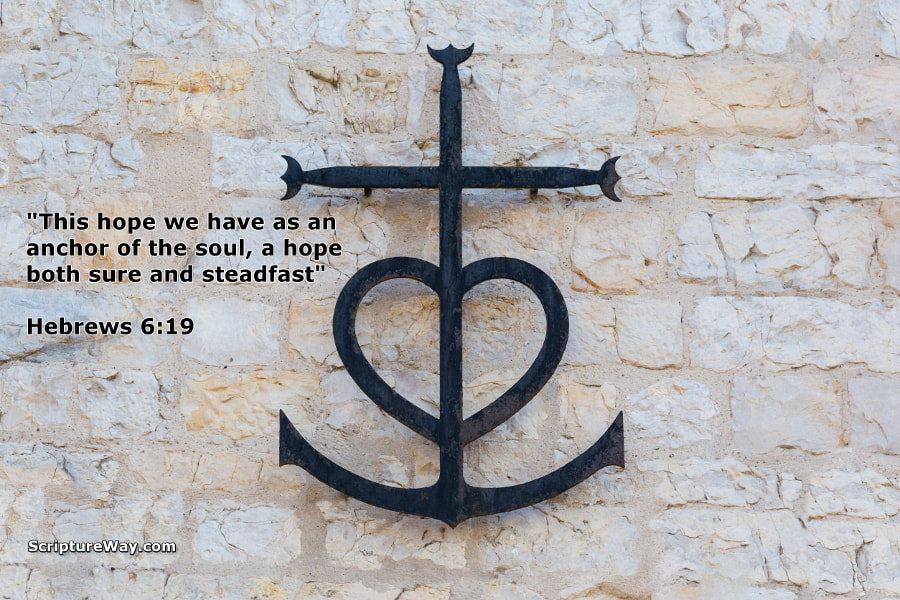
"This hope we have as an anchor of the soul, a hope both sure and steadfast and one which enters within the veil." (Hebrews 6:19)
"When all around my soul gives way, he then is all my hope and stay." -- Edward Mote (1797-1874), writer of the hymn, "My Hope is Built" (Ref. 1, Ref. 2).
Consider. When the storms of life come, in whom or in what is your soul secure, even when tossed by waves of trouble, grief, or loss? What is the anchor for your soul?
Hope Is an Anchor for the Soul
"This hope [this confident assurance] we have as an anchor of the soul [it cannot slip and it cannot break down under whatever pressure bears upon it]—a safe and steadfast hope that enters within the veil [of the heavenly temple, that most Holy Place in which the very presence of God dwells]." (Hebrews 6:19 AMP)
For believers in Jesus Christ, our hope -- our expectation for the future and our confident assurance for the present -- is an anchor for our soul (Hebrews 6:19). Hope accomplishes for our soul the same thing an anchor does for a ship (Ref. 3). In the same way that an anchor holds a ship sure and steadfast through a storm, our hope of heaven and eternal life with Christ holds us firmly and keeps us calm through the difficult storms of life. Our hope of heaven and eternal life with Christ cannot slip and it cannot break down under whatever pressure bears upon it (Hebrews 6:19 AMP). Edward Mote referred to Christ and to hope when he wrote the hymn line, "When all around my soul gives way, he then is all my hope and stay" (Ref. 1, Ref. 2).
Which enters within the veil
The writer of Hebrews adds that this hope set before us is "one which enters within the veil" (Hebrews 6:19). The Amplified Bible describes the veil as "the heavenly temple, that most Holy Place in which the very presence of God dwells" (Hebrews 6:19 AMP).
Recall that under the Old Testament system, the Most Holy Place, the innermost and most sacred place in the tabernacle and later the temple, was separated from the Holy Place by a veil (a curtain) (Exodus 26:31-33, 1 Kings 6:14-19, Hebrews 9:3). The Most Holy Place contained the ark of the covenant which was the symbol for the presence of God (1 Kings 8:6, 10-11). Only one person, the high priest, entered the Most Holy Place one day a year taking blood to atone for the sins of himself and the people (Hebrews 9:3, 6-7). During Jesus' earthly life, he did not enter the Most Holy Place in the human-made temple in Jerusalem. However, when Jesus Christ, the Messiah, the Son of God died sacrificially to atone for our sins, the veil of the temple was torn in two from top to bottom (Mark 15:37-39). Jesus Christ gained direct access for us to the holy place in heaven, the presence of God (Hebrews 9:24, Hebrews 10:19-21). Now, as believers in Christ, our hope has entered within the veil and is surely anchored in heaven, in the presence of God. Edward Mote wrote the hymn line, "In every high and stormy gale, my anchor holds within the veil" (Ref. 1, Ref. 2). A Living Hope (1 Peter 1:3)
"Blessed be the God and Father of our Lord Jesus Christ, who according to His great mercy has caused us to be born again to a living hope through the resurrection of Jesus Christ from the dead" (1 Peter 1:3).
Without the resurrection of Jesus Christ, there would be no anchor for our soul -- no hope, no eternal life. However, because of God's great mercy, and because of the death and resurrection of Jesus Christ, we do have an anchor for our soul. God has given us a secure living hope through believing in his Son and in his resurrection (John 11:25-26, 1 Peter 1:3). Jesus said to Martha, "I am the resurrection and the life; the one who believes in Me will live, even if he dies, and everyone who lives and believes in Me will never die. Do you believe this?" (John 11:25-26). A Hope that Abounds (Romans 15:13)
"Now may the God of hope fill you with all joy and peace in believing, so that you will abound in hope by the power of the Holy Spirit" (Romans 15:13).
The Apostle Paul prays for us as believers that God will fill us with joy and peace not just that we will have hope, but that we will abound in hope (Romans 15:13). The Greek word for abound means to overflow beyond measure (Ref. 4). The power of the Holy Spirit fills us with joy and peace, and our hope does abound -- a full assurance of hope until the end (Hebrews 6:11). Our abounding hope in Christ and eternal life is the anchor for our soul that keeps us steady and calm through the storms and trials of life.
Apply. Through whatever storm or trial you are going through, Jesus Christ and his gift of eternal life is your hope, the hope that is an anchor for your soul. Trust him, believe him, have confidence in him. Ask him to fill you with joy and peace by the power of the Holy Spirit so that your hope abounds, overflows without measure, and keeps you steady and calm, with full assurance of hope until the day you are with him in heaven.
Related Lessons
"What is Eternal Life?" (John 17:3) "I Am the Resurrection and the Life" (John 11:25-26)
Image: GoodSalt.com - used under license
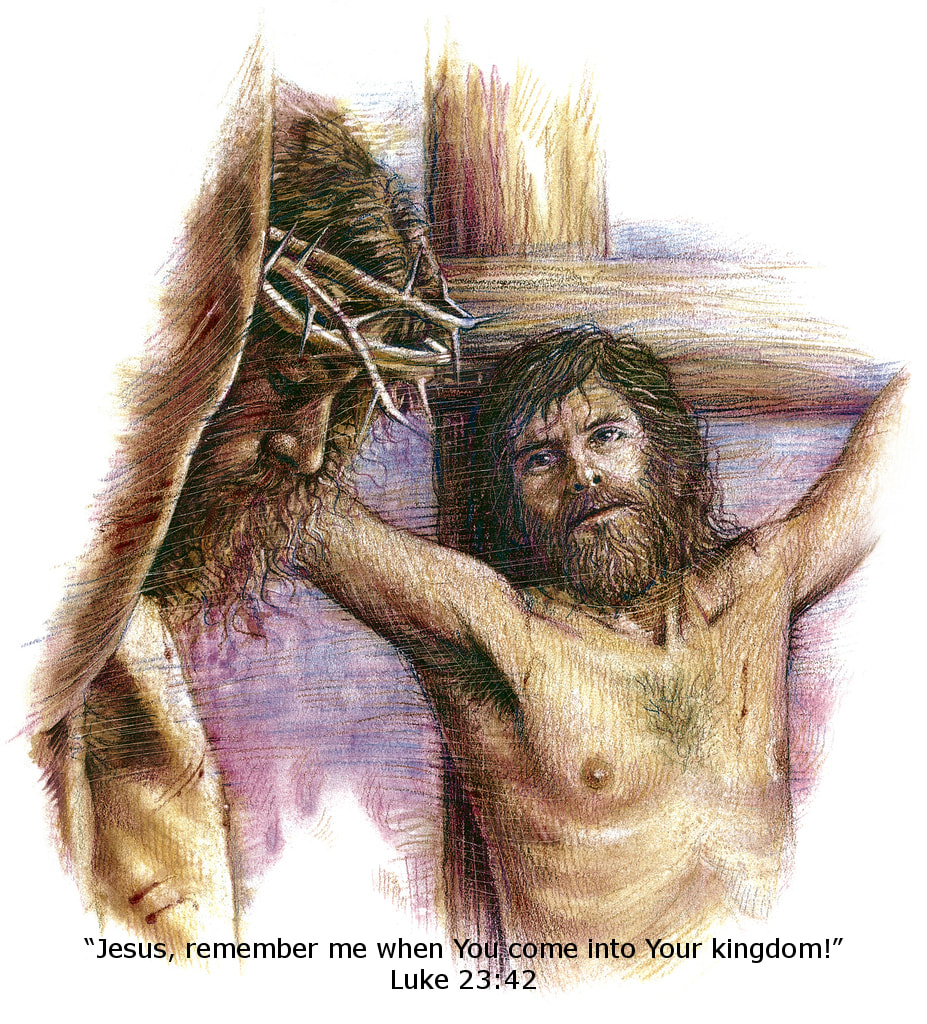
"And he was saying, 'Jesus, remember me when You come into Your kingdom!' And He said to him, 'Truly I say to you, today you will be with Me in Paradise.'" (Luke 23:42-43)
Consider. For the person who puts their faith in Jesus, upon the death of their body, their soul goes immediately to be with Jesus in Paradise.
Two thieves were crucified with Jesus that day - one on the right and the other on the left (Luke 23:33). Both thieves were next to the One who could save them. Yet, one thief hurled abuse (literally, blasphemed) at Jesus (Luke 23:39, Ref. 1). The other, penitent thief recognized that he himself was guilty yet Jesus was innocent. The penitent thief said, "Jesus, remember me when You come into Your kingdom!" (Luke 23:40-42). To this thief, the penitent thief, Jesus said, "Truly I say to you, today you will be with Me in Paradise" (Luke 23:43).
Jesus' promise to the penitent thief has brought hope to millions of believers over the centuries since Jesus' death and resurrection. Jesus' promise to the penitent thief brings believers hope today as we consider the destination of our souls upon our death and the destination of the souls of our loved ones.
In the next two sections, I would like to focus on two important points, or "take aways" from Jesus' promise to the penitent thief.
Paradise is Where Believers Will Be with Jesus after Death
Jesus could have told the penitent thief, "Today you will be in Paradise." But Jesus did not say that. Jesus said, "Today you will be with Me in Paradise" (Luke 23:43, underline added).
Paradise in Greek is paradeisos (par-ad'-i-sos), which is "an ancient Persian word meaning 'enclosure, garden, park'" (Ref. 2). Paradise is mentioned in the New Testament only three times - in Luke 23:43, 2 Corinthians 12:4, and Revelation 2:7. The Apostle Paul expressed his desire (his passionate longing) to be with Jesus after his death when he wrote, "But if I am to live on in the flesh, this will mean fruitful labor for me; and I do not know which to choose. But I am hard-pressed from both directions, having the desire to depart and be with Christ, for that is very much better" (Philippians 1:22-23, Ref. 3). Likewise, the early Christians were encouraged, that when they were absent from their body, they would be at home with the Lord (2 Corinthians 5:8, Ref. 4). Note that Jesus' promise to the penitent thief, "Today you will be with Me in Paradise," did not apply to the unrepentant thief who verbally abused Jesus and did not believe in him. Scripture teaches that the souls of the unrighteous go to the place of torment Jesus described in Luke 16:22-26 . There they await judgment and the second death (Revelation 20:11-15). It is far better to believe in Jesus during our earthly lifetime and to have his assurance that upon the death of our body our soul will be in Paradise with him. The Souls of Believers Immediately Enter Paradise to be with Jesus after Death
Jesus told the penitent thief, "Truly I say to you, today you will be with Me in Paradise" (Luke 23:43, underline added). Not tomorrow. Not some time in the future. Today. Jesus spoke to the penitent thief in language that he would understand. Even though their dead bodies would be on the cross or in the grave (Luke 23:50-53), the souls of the Savior and the penitent thief would be alive and in Paradise together that day (Ref. 5).
Another biblical example illustrates a believer's expectation of going immediately to be Jesus upon his death. At the time of his death from stoning, Stephen the martyr said, "Lord Jesus, receive my spirit!" Then he died (Acts 7:57-60).
Apply. Let the words of Jesus to the penitent thief comfort you as you consider the destination of your soul upon your death. "Truly I say to you, today you will be with Me in Paradise" (Luke 23:43).
Put your faith and trust in Jesus who is the Messiah, the Christ, the Son of God. You will receive God's gracious gift of eternal life (Romans 6:23), and upon the death of your body, your soul will go to Paradise to be with Jesus.
Related Lesson
"What is Eternal Life?" (John 17:3) "What is the Tree of Life in the Bible?" (Genesis 2:9, Revelation 2:7) "Where Does Your Soul Go When You Die?" - Genesis 35:18 |
Daily Bible Verse(Published on my Bluesky account) AuthorMr. Whitney V. Myers. Christian. For more information, please visit the Author Page. Posting ScheduleI plan to provide new postings about once a month. Planned Topics(subject to change) Recent Posts(most recent three publications) Popular Posts(top 10) Categories
All
Archives
October 2025
|


RSS Feed